
Professional Sports Hall Netting Systems: The Ultimate UK Facility Guide 2026

Can a single piece of infrastructure transform a cramped, single-use hall into a high-revenue, multi-sport hub? With over 679 million visits to UK fitness facilities recorded in 2025, the demand for versatile space is at an all-time high. Despite this growth, many managers still struggle with outdated sports hall netting systems that cause scheduling conflicts or fail to meet modern safety standards. It's a common frustration to lose booking revenue because your floor layout is too rigid or to feel uneasy about an upcoming inspection when your netting shows visible signs of wear.
We understand that facility management is about balancing performance with strict safety compliance. This guide provides the technical clarity you need to select, install, and maintain professional-grade netting that ensures full adherence to BS EN 1263 standards. You'll learn how to choose the right materials for long-term durability and how to implement an inspection regime that prevents hazards before they lead to a failed audit. We'll break down the essential components of a versatile multi-sport environment, from bespoke trackways to flame-retardant divider curtains, ensuring your facility remains safe and productive throughout 2026.
Table of Contents
The Role of Sports Hall Netting Systems in UK Facilities
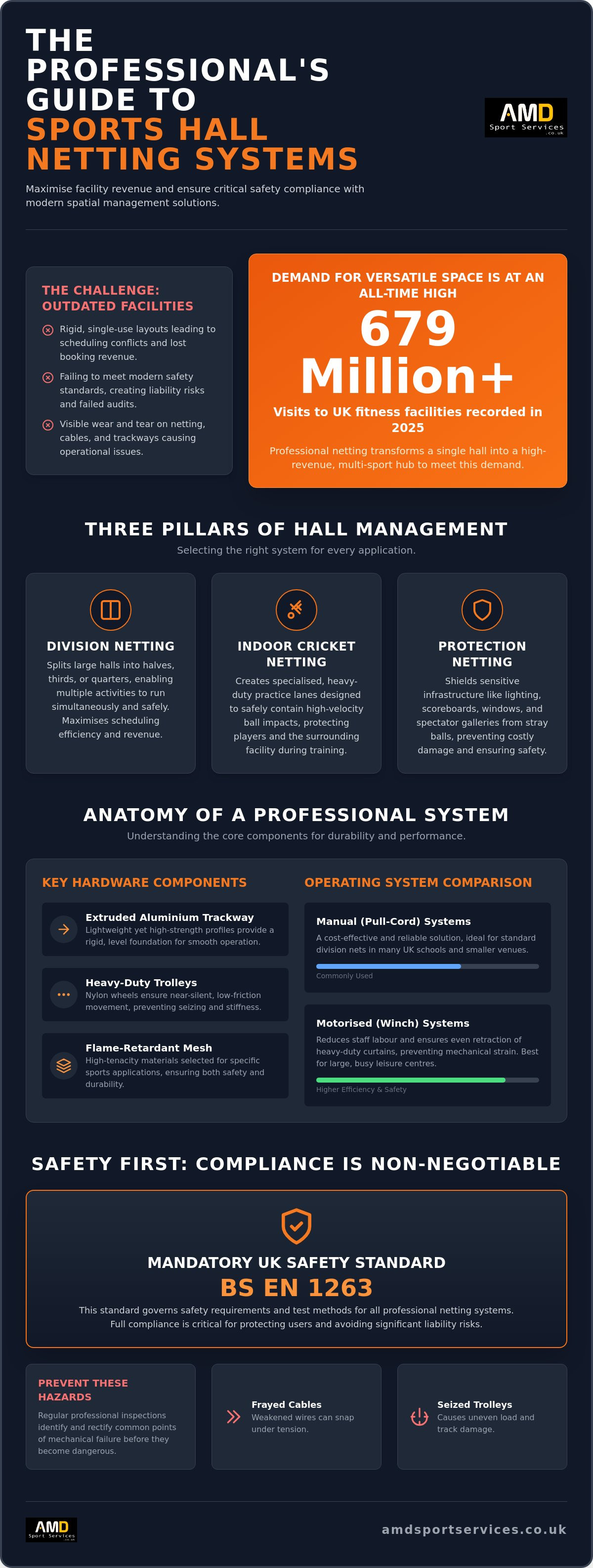
In modern UK leisure and educational environments, sports hall netting systems serve as much more than simple dividers. They are essential spatial management tools that allow a single large area to function as multiple independent zones. This versatility is critical for meeting the rising demand for indoor activity, which saw over 679 million visits to UK health and fitness facilities in 2025. By implementing a professional netting solution, facility managers can accommodate diverse groups simultaneously. This ensures that a high-intensity five-a-side match doesn't interfere with a quiet gymnastics session or a technical badminton drill.
Beyond simple division, these systems act as a primary layer of protection for the building's fabric. High-velocity impacts from footballs or cricket balls can cause expensive damage to ceiling-mounted lights, windows, and electronic scoreboards. Most UK facilities utilise three primary categories of netting to manage these risks:
Division netting for splitting halls into halves, thirds, or quarters.
Indoor cricket netting systems used to create high-velocity practice lanes.
Protection netting designed specifically to shield sensitive infrastructure like spectator galleries or ventilation units.
Maximising Multi-Sport Versatility
Effective spatial management directly impacts a facility's bottom line. When a hall is partitioned, it creates revenue-generating opportunities that a single-use space cannot match. High-quality division curtains do more than provide a physical barrier; they act as a visual and acoustic buffer. This reduction in distraction allows athletes to maintain focus, whilst the physical separation prevents stray balls from crossing into adjacent courts. Because many UK sports halls feature non-standard dimensions, bespoke trackway layouts are necessary to ensure the sports hall netting systems fit the structural profile of the building perfectly. A tailored approach prevents gaps that could lead to safety breaches or disrupted play.
Safety Standards and Compliance Overview
Safety is the primary driver for any equipment installation. Professional netting must comply with British Standards, specifically BS EN 1263, which governs safety requirements and test methods. Without a compliant system, facilities face significant liability risks. A failed inspection isn't just a paperwork issue; it represents a genuine hazard to users. We recommend regular indoor inspection and maintenance to identify frayed cables or seized trolleys before they cause a mechanical failure. Professional installation ensures that the tension loads on the building's steelwork are correctly calculated, protecting the hall's infrastructure from the long-term stress of heavy-duty netting systems.
Technical Specifications: Trackway, Wire, and Materials
A professional installation relies on the mechanical integrity of its hardware just as much as the quality of the mesh. High-performance sports hall netting systems consist of three primary components: the trackway, the trolley rollers, and the netting itself. Most modern facilities utilise extruded aluminium trackway profiles, which offer a balance of lightweight construction and high load-bearing capacity. Whilst manual pull out systems remain the standard for many UK schools, some larger leisure centres have began to opt for motorised winch systems. These motorised units reduce staff labour and ensure that heavy-duty curtains are retracted evenly, preventing the mechanical strain that occurs when nets are pulled haphazardly by hand.
Trackway Engineering and Structural Mounting
The mounting method depends entirely on the building's roof structure. Modern halls with universal steel beams allow for direct clamping, which provides a rigid and level foundation. In contrast, older facilities with timber trusses or complex concrete soffits require custom-fabricated brackets and drop-rods to bridge structural gaps. It's vital that the track is perfectly level; even a slight gradient can cause trolleys to migrate or seize. We use heavy-duty trolleys with nylon wheels to ensure near-silent operation and minimal friction. If your current system feels stiff or requires excessive force to move, it may be time to consider bespoke installation and engineering services to modernise your hardware.
Netting Material and Weight Options
Material science plays a significant role in the longevity of your system. Polyethylene (PE) is the preferred choice for most indoor environments due to its high break-strength and resistance to moisture. For multi-sport halls, a 50mm knotless mesh is typical, whilst specialised cricket bays require a smaller 20mm to 25mm mesh to contain high-velocity impacts. Stability is another critical factor. To prevent "billowing" caused by internal draughts or player movement, we recommend weighted bottom edges featuring lead cord or canvas-encased weights.
Fire safety is a legal requirement for any textile partition in a public space. All netting and divider curtains must adhere to BS 5867 Part 2 Type B for flame retardancy. This is a core component of the Sport England design guidance, which outlines the technical expectations for safe indoor play. To further improve durability, many facilities now specify heavy-duty PVC skirts at the base of their nets. These skirts protect the mesh from foot traffic and cleaning equipment, significantly extending the service life of the sports hall netting systems whilst providing a professional, clean finish at floor level.
Optimising Hall Usage: Division Curtains vs. Cricket Netting
Selecting the correct configuration for sports hall netting systems requires a clear understanding of the specific ballistic forces at play. Whilst a standard division net is designed to stop a drifting football or a stray shuttlecock, cricket netting must withstand high-velocity impacts from a 5.5oz leather ball. Choosing the wrong system doesn't just lead to premature wear; it creates a genuine safety risk for other hall users. A pragmatic approach to hall design involves matching the mesh density and track strength to the highest impact activity scheduled for that space.
Proper storage is equally critical for equipment longevity. When not in use, nets shouldn't be left bunched at the end of a track. They should be stored in heavy-duty PVC bags or "sausage" bags suspended from the trackway. This prevents the mesh from trailing on the floor where it can be snagged by footwear or damaged by aggressive cleaning chemicals. It also keeps the hall looking professional and organised for non-sporting events like exams or assemblies.
General Purpose Division Systems
Standard division netting typically features a 50mm knotless mesh. This size is ideal for most ball sports, providing a clear physical boundary without blocking excessive light. "Walk-along" systems are the most common choice for UK schools, allowing staff to reconfigure the hall in seconds without complex machinery. For facilities looking to enhance their branding, we provide coloured netting options. Darker colours like navy blue or forest green are often preferred as they provide better contrast against white shuttlecocks or yellow tennis balls, significantly improving the player experience.
Specialist Indoor Cricket Netting
Indoor cricket requires a significantly more robust setup than general division. The mesh size is reduced to 20mm or 25mm to ensure the ball cannot penetrate or become lodged. These sports hall netting systems require specialised roof-mounted tracks that can handle the increased weight of the tighter mesh and the repeated force of the impact.
Elite-level training environments also integrate canvas sight screens into the lane design. These screens provide a solid, neutral background for the batsman, mimicking professional match conditions and improving safety by isolating the play area. Because cricket nets are subject to intense focal stress at the bowler and batsman ends, we recommend regular indoor inspection and maintenance. This ensures that the high-impact zones haven't developed dangerous tears or weakened seams. For facilities looking to install new lanes, our indoor cricket netting solutions are designed to meet both ECB and Sport England specifications.
Safety Compliance and Maintenance: Protecting Your Investment
Facility managers hold a legal responsibility to ensure all suspended equipment remains fit for purpose and safe for public use. Under UK health and safety legislation, sports hall netting systems are classified as work equipment that requires regular, documented assessments. An annual professional safety inspection isn't merely a recommendation; it's a vital component of your risk management strategy. Neglecting this cycle leads to more than just mechanical failure. It exposes your organisation to significant liability if an accident occurs due to avoidable equipment fatigue. Maintaining a comprehensive inspection log is essential, providing the necessary evidence for insurance providers and local authorities that your facility meets its duty of care.
Regular servicing is particularly important for motorised trackway systems. These units rely on precise cable tension and limit switch accuracy to function correctly. When a system is serviced annually, engineers can identify seized trolleys or frayed wire cables before they cause a total operational shutdown. This proactive approach prevents the costly downtime that occurs when a hall becomes unusable due to a jammed divider curtain or a fallen net.
The Professional Inspection Process
A rigorous inspection follows a logical, three-step workflow to ensure no component is overlooked:
Step 1: Visual assessment. We examine the mesh for tears and verify that fire retardancy labels, compliant with BS 5867 Part 2 Type B, are present and legible.
Step 2: Load testing. Our engineers check the integrity of structural anchors and trackway fixings to ensure they can withstand the dynamic forces of high-velocity ball impacts.
Step 3: Mechanical check. We inspect trolley rollers for flat spots and pulleys for alignment. Motorised drives are tested for smooth operation and electrical safety.
Common Repairs and Refurbishment
Minor damage doesn't always necessitate a full system replacement. Small mesh tears can often be professionally stitched to restore the net's original strength whilst maintaining its aesthetic appearance. However, mechanical components like frayed cables or seized trolleys usually require immediate replacement to prevent further damage to the trackway. Some UK facilities are now choosing to upgrade older manual systems to motorised operation. This refurbishment significantly improves health and safety by removing the physical strain on staff who would otherwise have to pull heavy curtains by hand. If your facility is due for its yearly check, book your sports equipment safety inspection today to ensure your hall remains compliant and operational throughout 2026.
Bespoke Installation and Repair Services by AMD Sport Services
AMD Sport Services operates as a seasoned practitioner in the sports infrastructure sector, prioritising technical proficiency over marketing flair. Our work on sports hall netting systems begins with a thorough assessment of the building's unique structural characteristics. This pragmatic method ensures that every installation is bespoke, addressing specific challenges like low-hanging ventilation ducts or irregular beam spacing that standard products cannot accommodate. We don't just provide a service; we act as a technical partner for facility managers who value durability and compliance above all else.
Our commitment to national UK standards is absolute. We maintain strict adherence to BS EN 1263 regulations and fire retardancy requirements for every project we undertake. By focusing on accountability and technical honesty, we've built long-term partnerships with local authorities, schools, and professional sports clubs. Our inspection-first approach is designed to save facilities money over the long term. By identifying minor mechanical wear during a routine check, we prevent the need for expensive, large-scale refurbishments or the total replacement of winch posts and trackway systems.
Expert Installation and Mechanical Repairs
We provide comprehensive design services for both new builds and complex refurbishment projects. Our team handles the entire technical workflow, from initial load calculations on universal beams to the final mechanical commissioning of motorised winches. We specialise in the physical repair of all indoor and outdoor netting, ensuring that frayed cables or damaged mesh don't compromise user safety. This commitment to detail is a core part of our indoor inspection and maintenance service, where we resolve structural issues before they lead to facility downtime.
Our engineers are experts at solving unique structural challenges. In many multi-use halls, we've successfully integrated sports hall netting systems into older buildings where original architectural plans were no longer available. We use custom-fabricated brackets to ensure a level, secure installation regardless of the ceiling's complexity. This hands-on experience allows us to repair and modernise existing systems that other providers might deem beyond salvage.
Contact Us for a Professional Assessment
Booking a safety inspection with AMD Sport Services is a straightforward process designed for busy facility managers. We offer nationwide coverage, providing expert site visits for schools, councils, and private leisure centres across the UK. Our engineers arrive with the technical knowledge required to assess even the most complex multi-sport environments, providing clear, matter-of-fact reports on the condition of your equipment. For evidence of our craftsmanship and the diverse range of structural challenges we've solved, we invite you to view our recent AMD Sport Services projects. Contact our team today to ensure your facility remains safe, compliant, and ready for the demands of 2026.
Secure Your Facility's Future Performance
Maintaining high-performance sports hall netting systems is a continuous process that extends far beyond the initial installation. The key to a successful facility lies in selecting the correct mesh specifications for your specific sports whilst ensuring the mechanical hardware is engineered to suit your building's unique structural profile. Whether you are managing elite cricket lanes or multi-use school halls, adherence to BS EN 1263 safety standards remains the non-negotiable benchmark for protecting both your users and your investment.
Proactive maintenance is the most effective way to avoid operational downtime. Our team brings over 20 years of industry expertise to every site visit, offering nationwide service for UK schools and councils. We specialise in bespoke mechanical repairs that address the specific needs of your facility. It's vital that your trackways and winches operate with precision. This methodical approach guarantees that your spatial management tools remain reliable and compliant with current regulations. Take the first step towards a safer, more versatile environment today.
Book a Professional Safety Inspection for Your Sports Hall Netting
Frequently Asked Questions
How often should sports hall netting be inspected for safety?
Professional safety inspections for sports hall netting systems should occur at least once every 12 months. This annual cycle ensures that structural fixings and mechanical components remain compliant with BS EN 1263 standards. Whilst annual formal checks are mandatory for many insurance policies, facility staff should also perform monthly visual assessments to identify obvious mesh tears or frayed cables before they escalate into significant hazards.
Can I upgrade my manual netting system to a motorised one?
Yes, most manual "walk-along" trackway systems can be upgraded to motorised operation. This process typically involves installing an electric winch and motor drive unit, which ensures the netting is retracted evenly and safely. Upgrading reduces the physical strain on staff and minimises the risk of mechanical damage caused by improper manual handling. We assess your existing roof structure to ensure it can support the additional weight of the motor assembly.
What are the fire safety requirements for indoor sports hall curtains?
All indoor sports hall curtains and divider nets must be flame retardant to comply with BS 5867 Part 2 Type B. This British Standard is essential for public buildings, including schools and leisure centres, to ensure that textile partitions don't contribute to the spread of fire. You should verify that your equipment features a permanent label confirming this compliance, as inspectors will check for this during their annual safety assessment.
What is the best mesh size for multi-sport division netting?
A 50mm knotless mesh is the industry standard for general-purpose multi-sport division netting. This size effectively contains footballs, basketballs, and tennis balls whilst allowing for maximum light penetration and visibility across the hall. If your facility hosts specialised activities like cricket, you will require a smaller 20mm to 25mm mesh for those specific bays to contain high-velocity impacts safely and prevent ball penetration.
How do I repair a tear in my sports hall cricket netting?
Small tears in cricket netting can often be repaired through professional lacing or stitching using high-tenacity twine. It's vital to address these tears immediately, as the high-velocity impact of a cricket ball will quickly expand any minor hole. If the damage is extensive or located in a high-impact zone like the batsman's end, we recommend a full panel replacement to maintain the structural integrity and safety of the lane.
Are there specific height requirements for sports hall dividers?
There are no rigid universal height requirements, but most professional dividers are designed to reach the hall's eaves or the underside of the roof structure. This full-height approach prevents balls from being hit over the partition and into adjacent courts. For standard UK leisure centres, this typically results in a netting height of between 6 and 9 metres, bespoke to the building's specific architectural dimensions and structural constraints.
What is the difference between a division net and a division curtain?
A division net consists entirely of open mesh, whereas a division curtain typically features a solid PVC or canvas skirt at the base with mesh above it. Curtains provide a more robust visual and acoustic barrier, making them ideal for separating high-distraction activities. The solid bottom section also protects the equipment from floor-level wear and prevents small balls from rolling under the partition into other active play areas.
How long does a typical sports hall netting installation take?
A standard installation for sports hall netting systems usually takes between one and five working days. This timeframe depends on the complexity of the trackway layout and the accessibility of the roof structure. Refurbishment projects or motorised upgrades may require additional time for electrical commissioning. We plan our workflows to minimise facility downtime, often scheduling work during school holidays or off-peak periods to avoid disrupting regular bookings.


Comments