
Professional Basketball Goal Installation Services for UK Sports Facilities

A basketball goal system is a structural installation first and a piece of sports equipment second. When you are responsible for a high-use UK sports facility, the difference between a successful project and a liability risk often comes down to the quality of the fixings and the precision of the assembly. Many facility managers feel the pressure of coordinating between equipment suppliers and site schedules, whilst worrying if the final result will actually meet the BS EN 1270:2005 safety standard.
We understand that your primary goal is a durable, compliant setup that doesn't disrupt your hall's busy timetable. This guide explains how professional basketball goal installation services bridge the gap between technical regulations and practical facility management. You will learn how to select the right system for your structural environment, what to expect during the installation process, and how to maintain your equipment to ensure it passes every annual safety inspection with ease. By focusing on structural integrity and official standards, you can provide a safe environment for players and maintain full compliance with your insurance requirements.
Table of Contents
Professional Basketball Goal Installation Services: Safety and Compliance
Professional installation is a technical process that involves structural mounting, precise levelling, and mandatory safety certification. For institutional facilities like schools, colleges, and leisure centres, the requirements go far beyond basic assembly. Whilst a general contractor might be able to fix a bracket to a wall, they often lack the specific knowledge required to ensure the system remains stable under the dynamic loads of competitive play. Using dedicated basketball goal installation services guarantees that your equipment is fitted by experts who understand the unique mechanical stresses involved. This professional approach is essential for passing annual health and safety audits and maintaining your facility's insurance coverage. A specialist installer will conduct a structural assessment of the building's fabric before any work begins, ensuring that the walls or ceiling can support the weight and leverage of the chosen system. This proactive approach prevents future structural damage and ensures the longevity of both the equipment and the building itself.
Understanding BS EN 1270 Standards
The BS EN 1270:2005 standard is the benchmark for basketball equipment safety in the UK. This regulation defines the functional and safety requirements for eight distinct types of equipment, ranging from wall-mounted units to ceiling-hung systems. It addresses critical factors such as the load-bearing capacity of the rim and the stability of the support structure. One of the most important technical details is the hoop-to-backboard connection; the rim must be mounted in a way that transfers force directly to the support frame. Reviewing basketball backboard specifications provides further insight into how materials like cast aluminium must be handled to prevent structural fatigue and ensure compliance with official competition requirements. Adhering to these standards ensures that the equipment can withstand the rigours of a high-traffic sports hall without compromising user safety.
The Risks of Improper Installation
Choosing an unqualified installer introduces significant structural risks. In a high-use environment like a secondary school, a poorly secured wall-mounted goal can suffer from masonry failure, leading to a catastrophic collapse. This isn't just a maintenance issue; it's a major liability. If a system fails an inspection because it wasn't installed according to BS EN 1270, the facility manager may face legal repercussions. Professional external sport equipment installation eliminates these uncertainties by providing a documented trail of compliance. Poor fitting also accelerates the wear of rims and nets, leading to unnecessary replacement costs within the first year of use. By investing in professional basketball goal installation services, you protect both your budget and the physical wellbeing of the athletes using your facility.
Technical Specifications for Institutional Basketball Systems
Selecting the right hardware is a balance between performance and structural reality. Professional basketball goal installation services start with identifying the correct backboard material for the environment. Tempered glass offers the highest rebound quality for competitive play, whilst cast aluminium provides unmatched durability in unsupervised outdoor settings. For many UK schools and multi-use halls, high-density wood or composite boards remain a practical and cost-effective choice. Every component must align with BS EN 1270:2005 safety standards to ensure the system handles the specific stresses of institutional use. Safety padding is another essential addition; it must be fitted to the bottom and sides of the backboard to prevent head injuries during play.
Backboard and Rim Engineering
Rectangular backboards measuring 183cm wide by 107cm high are the standard for professional and high-level club play. Fan-shaped boards are often used in smaller halls where space is restricted. The rim is the most critical safety component. Breakaway (pressure-release) rims use a spring mechanism to flex when a specific load is applied. This prevents the backboard from shattering and reduces the impact force on a player's joints during a dunk. For nets, nylon is preferred indoors for noise reduction and visibility, whereas steel chain nets are typically reserved for outdoor courts to resist weathering.
Structural Mounting and Brackets
Older UK sports halls often present challenges with masonry strength. Installing a heavy system requires calculating the exact projection length. This is the distance from the wall to the backboard, which must be sufficient to ensure players don't collide with the wall during a layup. If the wall is made of older, brittle brick, we use bespoke spreader plates to distribute the load across a larger surface area. Bracing is equally vital; it minimises the vibration that occurs after a ball hits the rim, which otherwise creates excessive noise and loosens fixings over time. We often fabricate custom brackets to accommodate non-standard wall configurations or to avoid existing pipework and ventilation ducts.
The final stage of any installation involves synchronising the equipment with the court markings. The hoop must sit exactly 3.05 metres (10 feet) above the floor and be perfectly aligned with the baseline. If you're planning a facility upgrade, you can view our previous basketball installation projects to see how these technical specifications are applied in real-world environments. This level of precision ensures the facility is ready for both recreational use and official league competition.
Comparing Wall-Mounted, In-Ground, and Ceiling-Hung Systems
Choosing the right configuration requires an assessment of your facility’s primary function. Multi-use halls often need to clear the floor for exams or other sports, whilst dedicated basketball centres can prioritise permanent fixtures. Professional basketball goal installation services should provide a detailed site survey to determine which system suits your building’s structure. Structural integrity is the priority; a ceiling-hung system requires a different load-bearing capacity than a wall-mounted bracket. For outdoor, free-access equipment, installers must follow BS EN 15312 Safety Standards to ensure the system is safe for public use without direct supervision.
Outdoor playgrounds usually benefit from permanent in-ground systems. These offer superior stability and resistance to vandalism in unsupervised areas. However, they require significant excavation and concrete work, making them a permanent commitment. Indoors, the choice often falls between fixed-height and adjustable-height systems. Fixed-height units are the standard for regulation play at 3.05 metres. Adjustable systems are a practical investment for primary schools or youth centres, allowing the rim to be lowered for younger players. When facilities choose professional basketball goal installation services, they gain access to bespoke advice on whether a fixed or adjustable height system better serves their specific community needs.
Wall-Mounted Systems for Schools
Wall-mounted goals are the most common choice for UK schools due to their space-saving benefits. In a hall used for assemblies and exams, these units stay out of the way. Side-folding mechanisms are essential in multi-sport environments. They allow the goal to be folded flat against the wall, preventing it from obstructing badminton courts or netball sidelines. This flexibility ensures the hall remains functional for various activities without compromising the quality of the basketball setup. For more technical detail on these systems, read our professional guide to wall mounted basketball goals for UK facilities.
Ceiling-Hung and Portable Options
Ceiling-hung goals are the gold standard for high-performance sports centres. They allow for a completely clear floor, which is vital for elite-level competition. These systems typically use electric winches to raise and lower the goals. This mechanisation simplifies the transition between different sports, saving time for facility staff. However, motorised systems require more intensive maintenance. The cables, winches, and safety locks must be inspected regularly to prevent mechanical failure. You can find further details in our guide to indoor basketball goal fitting. Portable units offer an alternative for facilities where the structure cannot support wall or ceiling loads, though they require significant storage space when not in use.
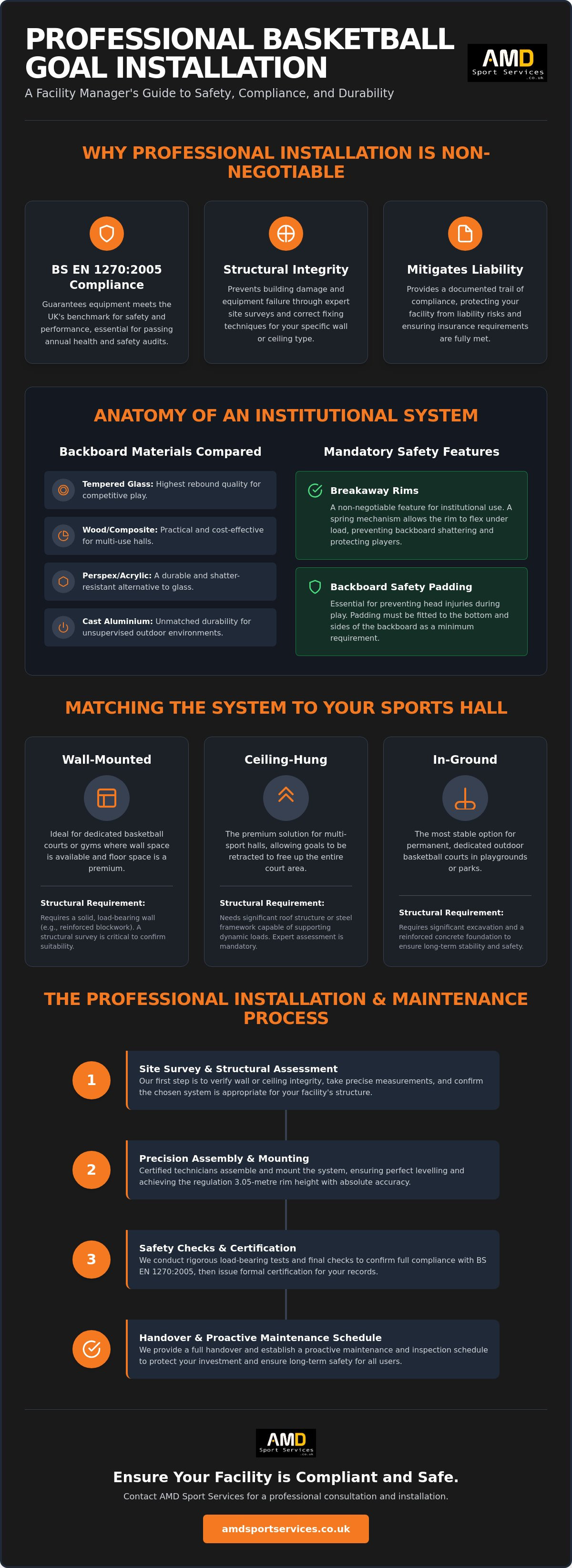
The Professional Installation Process: From Survey to Handover
A successful project is the result of a methodical sequence that begins long before the first bolt is tightened. Professional basketball goal installation services rely on a systematic workflow to eliminate site-specific risks and ensure structural longevity. This process moves from a technical assessment of the building's fabric to the high-precision calibration of the playing hardware. By following a chronological checklist, we ensure that the equipment is not only functional but stays safely within the tolerances required for institutional use. The goal is a seamless transition from a construction site to a competition-ready facility with zero disruption to your operational schedule.
Site Survey and Preparation
The pre-installation site survey is the most critical phase for risk management. We begin by identifying hidden services such as electrical conduits or water pipes and locating structural steel beams within the walls or ceiling. This prevents accidental damage during the drilling and fixing process. For indoor facilities, we assess the floor surfacing to ensure it can support the point loads of access equipment like scissor lifts. We also check the floor's levelness; even a minor slope can affect the stability of portable units or the vertical alignment of wall-mounted brackets. Organising the correct plant and access equipment in advance ensures the work is completed safely and efficiently.
Assembly and Precision Calibration
Laser levelling provides a consistent datum point across the entire sports hall, making it significantly more accurate than spirit levels for achieving the regulation 3.05-metre rim height. Once the height is set, we focus on 'plumbing' the backboard. A backboard that isn't perfectly vertical will cause an inconsistent bounce, which directly affects the quality of play. We then apply a calibrated test load to the rim to simulate the forces of active play and verify that the fixings don't shift under pressure. This physical verification is essential for confirming the structural integrity of the entire system before it's cleared for use.
The final stage of the process involves testing the tension and torque of every fixing to the manufacturer's exact specifications. We don't rely on guesswork; we use calibrated tools to ensure every bolt is tightened correctly. Once the installation is complete, we provide a final safety sign-off and issue a compliance certificate for your records. This document is vital for your insurance and health and safety files, proving that the equipment meets all relevant UK standards. If you're ready to upgrade your facility, you can request a professional installation survey to ensure your project starts on a solid structural foundation.
Ensuring Long-Term Performance: Maintenance and Safety Inspections
Professional basketball goal installation services provide the structural foundation, but the rigours of daily play in a busy sports hall mean that hardware requires ongoing attention. For institutional facilities, installation is merely the beginning of the equipment's lifecycle. High-use environments put immense stress on mounting brackets, pivot points, and rim mechanisms. Over time, the vibration from ball impacts and the dynamic loads from players can loosen fixings or cause material fatigue. We recommend that high-traffic facilities undergo a professional safety inspection at least once every twelve months to remain compliant with UK health and safety requirements. This proactive approach identifies minor issues before they escalate into structural failures or liability risks.
Common wear-and-tear issues often include frayed nylon nets, which can become a finger-entrapment hazard, or loose bolts that compromise the backboard's stability. In motorised ceiling-hung systems, we frequently monitor for hydraulic leaks or cable fraying in the winching mechanism. AMD Sport Services specialises in bridging the gap between initial setup and long-term reliability. We integrate our installation work with comprehensive maintenance plans, ensuring that your equipment remains as safe and stable as the day it was first fitted. This continuity of care is essential for protecting your investment and ensuring the safety of all facility users.
Annual Safety Inspections and Repairs
A professional basketball goal safety audit follows a rigorous checklist. We examine the integrity of the backboard, the functionality of the breakaway rim springs, and the torque levels of all structural fixings. If a component shows signs of excessive wear, we replace it immediately using parts that meet the original manufacturer's specifications. This prevents the "domino effect" where one loose bracket causes increased vibration and damage to the rest of the assembly. You can learn more about our indoor inspection and maintenance services to see how we help facilities maintain their safety certification year after year.
The Role of the Facility Manager
Whilst annual professional audits are mandatory, the facility manager plays a vital role in day-to-day safety. Staff should perform a quick visual check before every session. They should look for visible gaps between the backboard and the rim, loose netting, or any unusual noise when the system is lowered. Keeping a formal maintenance log is also a critical requirement. This document demonstrates your commitment to compliance and provides a clear audit trail for insurance inspectors. If you're planning a new project or need to upgrade an existing hall, contact AMD Sport Services for a professional installation quote. We provide the technical expertise needed to keep your sports facility running safely and efficiently.
Securing Your Facility's Structural Integrity
Establishing a safe and compliant basketball environment requires more than just high-quality hardware. It demands a technical understanding of structural loads and a commitment to the BS EN 1270:2005 safety standard. By choosing specialist basketball goal installation services, you ensure that your facility is built on a foundation of precision engineering and regulatory compliance. Whether you are managing a primary school hall or a national leisure centre, the focus must remain on long-term durability and the physical safety of every player who steps onto the court.
AMD Sport Services offers national UK coverage, bringing over 20 years of specialist industry experience to every project. We provide a comprehensive safety certification with every installation, giving you the official documentation needed for insurance and health and safety audits. Our team handles the entire workflow; we manage everything from the initial structural survey to the final load testing and handover. Taking the right steps during the planning phase prevents structural failures and avoids the cost of premature equipment replacement. You can book a professional site survey for your basketball goal installation to begin your project with confidence. We look forward to helping you create a high-performance sports environment that serves your community for years to come.
Frequently Asked Questions
What is the standard height for a professional basketball goal installation?
The regulation height for a professional basketball rim is exactly 3.05 metres (10 feet) from the floor surface to the top of the ring. This measurement is the official standard for all adult competition under FIBA and Basketball England regulations. For primary schools and junior coaching, we often install adjustable systems that allow the rim to be lowered to 2.60 metres (8.5 feet) to accommodate younger players whilst maintaining the same structural standards.
Do I need a structural survey before installing wall-mounted basketball goals?
Yes, a technical assessment of the wall's load-bearing capacity is an essential first step in our basketball goal installation services. We must verify that the masonry or steelwork can handle the static weight of the backboard and the dynamic forces generated when a ball hits the rim. If the building fabric is older or non-standard, we often design and fit bespoke spreader plates to distribute the tension safely across a larger area, preventing structural damage.
How often should school basketball goals be professionally inspected?
School basketball goals must undergo a professional safety inspection at least once every 12 months to comply with UK health and safety standards. High-traffic leisure centres and professional academies often opt for bi-annual checks due to the constant mechanical stress placed on the equipment. These regular audits are vital for identifying frayed nets, loose fixings, or structural fatigue that could lead to a serious accident if left unaddressed.
What is the difference between BS EN 1270 and other safety standards?
BS EN 1270:2005 is the specific European standard for basketball equipment used in institutional, public, and competitive environments. Unlike standards for residential or garden hoops, it mandates rigorous testing for load-bearing capacity, entrapment prevention, and stability under heavy use. Compliance with this standard is usually a mandatory requirement for facility insurance and ensures that the equipment is safe for unsupervised public use in parks or sports halls.
Can you install basketball goals in a multi-use sports hall with partition netting?
We can install basketball systems in halls with existing partition netting, though it requires precise coordination during the site survey. The main challenge is ensuring the goal's projection or side-folding mechanism doesn't obstruct the netting trackway or snag the curtains. We often solve these issues by fabricating custom brackets that allow the goal to sit at a specific depth, ensuring both the basketball setup and the netting remain fully functional.
How long does a typical professional basketball goal installation take?
A standard wall-mounted goal installation typically takes one working day to complete, provided the site is cleared and the structural survey is already finished. More complex projects, such as motorised ceiling-hung systems or in-ground units that require concrete foundations to cure, can take between three and five days. We always aim to schedule these works during school holidays or off-peak hours to ensure minimal disruption to your facility's timetable.
Is it possible to automate the lowering and raising of ceiling-hung goals?
Yes, most modern ceiling-hung basketball systems are fitted with electric winches that allow for fully automated operation via a wall switch or remote control. This automation is a practical choice for multi-use halls where staff need to transition between sports quickly. These systems include essential safety features such as electronic limit switches and secondary safety locks to ensure the goal remains securely in place whether it is in the playing or stored position.
What happens if our basketball equipment fails a safety inspection?
If equipment fails an inspection, it must be decommissioned immediately and marked as "out of use" to prevent any liability or injury. We provide a detailed technical report explaining the failure, whether it's a mechanical fault in a winch or a structural issue with a wall bracket. After performing the necessary repairs or component replacements, we re-test the system and issue a new compliance certificate to confirm the equipment is safe for use.


Comments