
Portable Football Goal Care & Maintenance Guide

A portable football goal must be securely anchored whenever it’s left in its play position. This portable football goal care and [maintenance](https://www.amdsportservices.co.uk/indoor-inspection-and-maintenance) guide explains how secure anchoring, regular visual inspections and dry, sheltered storage help keep movable goals safer and in serviceable condition. It’s easy to focus on the frame and net, but stability matters just as much. Freestanding goals must always be securely anchored or sufficiently weighted to prevent them from toppling over, and children shouldn’t use a movable goal until it’s securely anchored. Do not move or wheel goals individually. Moving a goal alone places excessive stress on its components, and aluminium goals are especially susceptible to cracked corner joints, broken wheel mounting points and weld failures. Never manoeuvre a goal using the rear diagonal support struts, as these are thin and can bend or snap. A minimum of two people must move a goal. Do not force it in a direction that is misaligned with the wheels’ orientation, as this can damage the wheel mechanism and sidebar. Once the goal is in position, lower it off its wheels. Never leave it permanently elevated on its wheels, as this can cause the mounting points to snap. Never swing or hang from the crossbars. When replacing or upgrading wheeling equipment, invest in 360-degree wheels rather than standard lift-and-lower wheels. Designs that sleeve around the entire sidebar, rather than bolting onto the top, provide significantly greater strength and make manoeuvring much easier. This guide covers anchoring, caring for goal frames and nets, moving goals safely, arranging regular inspections, and storing goals safely when they’re out of use. It helps schools, clubs and facilities teams know what to check and when professional football goal repairs or sports equipment inspections may be needed.
1. Goal weights and anchoring to prevent tipping
In the UK, BS 8461:2005+A1:2009 covers the procurement, installation, maintenance, storage and inspection of football goals. According to the European Committee for Standardization, adult football goalposts are covered by BS EN 748. These standards provide a framework for assessing whether goal installation and securing arrangements are appropriate.
Movable goals are safe to use only when their anchoring arrangement suits the goal and playing surface. Freestanding goals must always be anchored, and portable goals need sufficient counterweights or anchors whenever they’re left in their playing position. Children should not use a freestanding movable goal until it is securely anchored.
The right arrangement depends on the equipment. Socketed goals should be securely concreted into the ground, while freestanding frames rely on suitable anchors or counterweights. Secure locks and fittings, and don’t use non-conforming ground sockets. A fitting designed for one installation type may not stabilise another.
Surface conditions affect how the goal can be secured. Grass can accommodate suitable ground anchors, whereas artificial grass or a hard surface may require a counterbalance arrangement. Large portable goals need sufficient weight or anchoring to reduce the risk of tipping, particularly on hard surfaces or in windy conditions. A professional assessment considers the goal’s design, weight, installation position and surface together.
An elliptical foldaway goal shows why the model matters. It is designed for use on grass with multi-surface anchors or on artificial grass with counterweights. Permanent anchor points can also secure it in a fixed match position. These options apply to that design, not every portable frame.
Frame weight also affects how the surrounding area is managed. Freestanding goal frames weighing more than 45 kilos require additional care and attention around children. Weight alone does not secure a goal; an unsecured heavy frame can still tip. A school or club therefore needs an arrangement that accounts for both the frame and how it is positioned for training or play.
Where the anchoring system, fittings or installation raise concerns, professional assessment can identify whether repair or adjustment is required. Sports equipment maintenance can address goal condition and securing components as part of the equipment’s upkeep, helping facilities determine whether the current arrangement is suitable for continued use.
For outdoor goals, the guide advises securing outdoor goals with net pegs or anchors to keep them stable during play. This makes the securing step part of preparing the goal for use, rather than relying on its position alone. The appropriate method should be in place before play begins, so the goal is supported while it is being used. A check of the securing arrangement can also help ensure that the goal has not been left without the support intended to keep it stable.
For garden goals, the guide advises checking that garden goals include goal pegs for stability. This check helps confirm that the equipment includes the pegs intended to support stability. If goal pegs are not included, the goal should not be assumed stable simply because it is set in position. Making the check before use helps keep attention on the goal’s securing needs as well as its location. Together, these measures provide a straightforward way to address stability for outdoor and garden goals.
2. What kind of yearly maintenance should I be doing on my football goal?
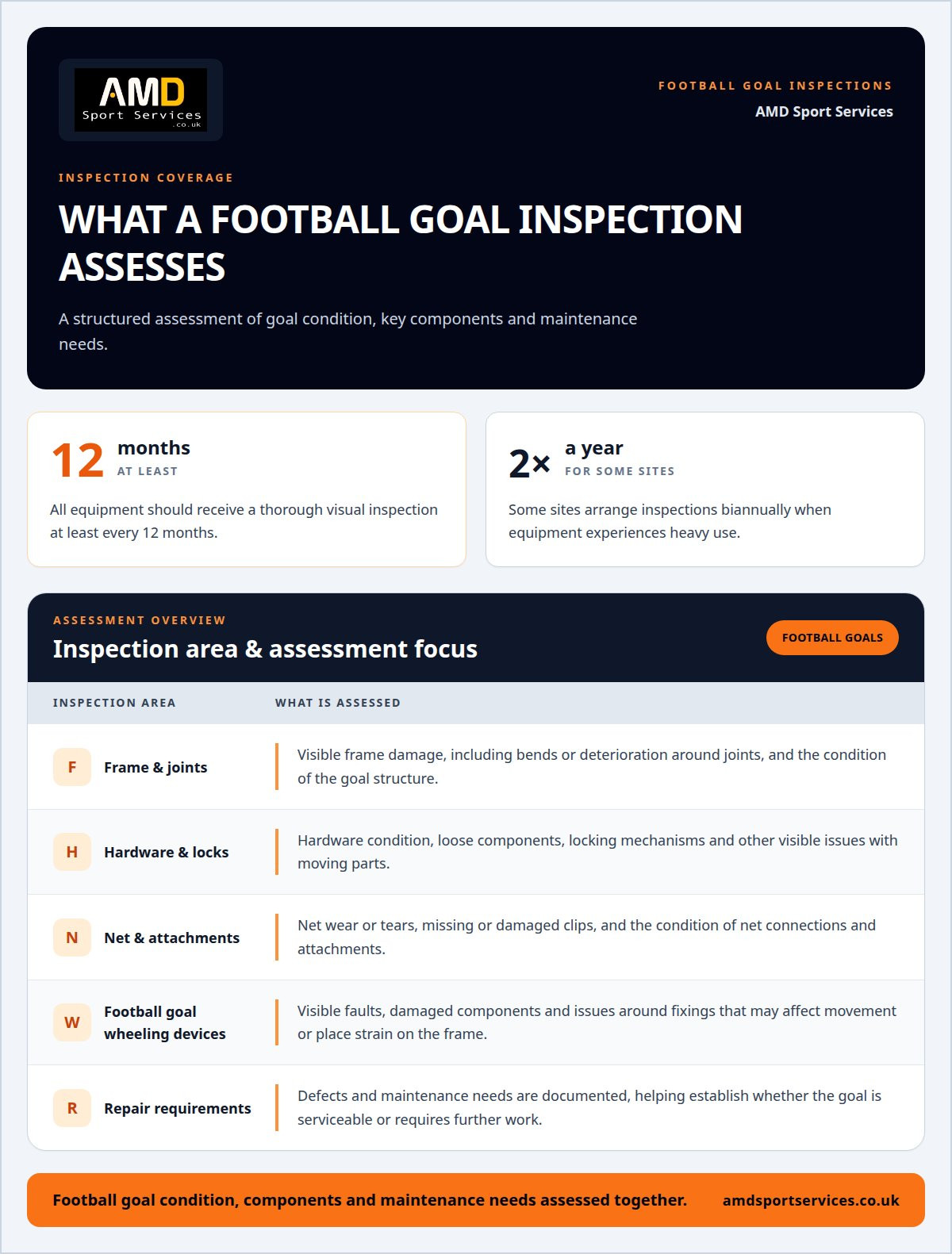
Football goals should receive weekly visual inspections and a detailed annual inspection. A thorough visual inspection should take place at least every 12 months, while some sites arrange inspections biannually when equipment experiences heavy use. Sports equipment safety inspections provide a structured assessment of goal condition and identify maintenance or repair needs.
Visual checks before play are a useful part of a site routine, particularly where goals are used frequently for training. Check frame connections, net attachments, anchors, locking mechanisms and visible damage. A weekly check can reveal changes between detailed inspections, such as a loose fitting after a busy session or an attachment damaged during a match.
An annual inspection assesses hardware for looseness and condition. Check football goals once a year for loose hardware and tighten loose components. Look for visible damage to the metal frame, including bends or deterioration around joints. If damage affects the goal’s structure, repair or replace it before returning it to service.
Assess the net and its attachments together. Missing or damaged clips can contribute to net wear, so check that connections are secure and in good condition. Look for tears and wear in the net, including damage associated with climbing. This helps distinguish a netting fault from a frame issue that needs separate repair.
For portable goals, include the wheeling devices in the inspection. Faults can affect movement and put strain on the frame during repositioning. Look for damaged components or visible problems around the fixings, as well as issues with other moving and locking parts.
Garden, school and club goals may be used differently, but each assessment should focus on condition and function. Timely maintenance is particularly relevant where goals are used for frequent training and matches. Keep a damaged goal out of service until it has been repaired.
Sports equipment safety inspections can document goal defects and maintenance needs, giving facilities a clear basis for arranging repairs. Checks may cover the frame, net attachments, hardware and wheeling devices. The findings help establish whether a goal is serviceable or needs further work before use resumes.
Regular inspection planning can combine weekly visual checks with the annual assessment and, where use is heavy, biannual inspections. Sports equipment maintenance can address identified faults and help keep goal equipment in suitable condition for school or club use.
3. Care for heavier freestanding goal frames
Heavier freestanding frames place particular demands on joints, attachments and accessories. Professional football goal maintenance assesses these parts as one assembly, since a fault in a connection or support can affect the frame during training and matches. The assessment looks for visible wear, structural damage and components that may need repair.
Dirt, mud, and rubber granules can collect on aluminium frames, especially around joints and fittings. Rinse away deposits with water so the frame’s surface is easier to assess. Cleaning removes residue, but it won’t fix a bend, damaged joint or loose connection.
After an impact, repair work can address the affected section and its connections. A bend or other structural fault can affect the frame’s shape, so an assessment should establish whether the component remains serviceable. If it doesn’t, football goal repairs can address the damaged part before the equipment returns to use.
Net attachments and accessories are also part of the assembly. A missing or damaged clip can affect how the net sits against the frame, while worn netting may need replacing. Maintenance considers related faults together, rather than treating a heavy frame as sound just because its main rails look intact.
Goal size and frame construction affect the type of wear and repair required. A larger frame has multiple joints and support points, so damage at one connection can affect how adjoining components fit. A professional assessment can distinguish surface residue from a fault affecting the frame’s integrity, helping determine whether cleaning, adjustment or repair is appropriate.
Accessories also contribute to the frame’s overall condition. Locking parts, net fittings and wheeling devices each have a specific function. If a moving component is damaged or a fitting no longer holds securely, repair work can target that fault instead of treating the whole frame as one problem.
Regular professional attention is particularly useful for goals that are handled frequently or take repeated impacts. Repairs can address frame damage, worn net attachments and faulty accessories, separately from routine cleaning. A goal with structural damage should not return to use until the fault is repaired.
Football goal repair and sports equipment maintenance provide a practical route when a heavy freestanding frame has a fault that routine cleaning cannot resolve. Goal repair and maintenance can address damage to the frame, fittings and related components, helping facilities manage the equipment’s condition.
4. Dry, sheltered storage
For extended periods out of use, store portable goals in a dry, sheltered place. This is useful at the end of a season, when a school or club may leave goals unused between playing programmes. A sheltered location limits exposure and keeps stored equipment away from active playing areas.
Choose a stable storage position. If a goal frame is stored against a wall, secure it with suitable brackets. If brackets aren’t available, place the frame flat on the ground, face down. Don’t leave a heavy frame leaning unsecured against a wall, where it could fall.
The transport position is for moving goals, not long-term storage. Don’t store a portable goal permanently on its transport wheels, as this can put excess stress on corner joints and mounting points which leads to premature strain. Once it reaches the storage area, place it flat or secure it with suitable brackets.
Safe handling helps protect the frame. Trained people should move goals using proper lifting techniques, never dragging them across the ground. At least four adults should move a full-sized goal. Keep the rear ground frame attached when moving larger goalposts. Dragging can strain joints and fittings, while uneven ground can make a frame difficult to control.
Check a goal’s condition before moving it into seasonal storage. A bent frame, damaged joint or loose attachment can make lifting and placing it less stable. Storage won’t fix existing faults, so keep a damaged goal out of use until it’s repaired. Keep netting and accessories with the goal rather than leaving them in a playing area, where they could be damaged or misplaced.
Socketed goals differ from freestanding portable frames because their posts are secured in ground sockets. They are not stored like a wheeled goal between sessions. For portable equipment, however, keeping the frame out of its transport position and in a dry, sheltered location provides a clear storage routine for clubs, schools and facilities teams.
At the start of the next playing period, move the goal from storage to a suitable, stable position before use. Handle the frame without dragging it, and address any visible damage found during storage before training or matches resume. A designated storage place also reduces the chance of a goal being left unsecured after use.
5. Portable football goal maintenance
Portable football goals need care between sessions, not just an annual inspection. Use this portable football goal care and maintenance guide to keep records of the frame, netting, attachments and moving parts. Coaches can note faults found during use so repairs aren’t overlooked before the next session.
Rinse dirt, mud, and rubber particles from the 3G surface from aluminium frames with water. Pay particular attention to joints and fittings, where residue can gather, so damage is easier to see. Cleaning removes grime; it won’t fix a bent section, loose connection or other structural fault.
Check netting separately, along with its attachment points, as missing or damaged clips can contribute to wear. Incorrectly secured nets often get caught up in the wheels, and will then rip and require replacing. Replace damaged net clips promptly, before a small tear spreads through the mesh. A sound frame alone doesn’t make a goal ready for play if its net is torn or insecure.
Use replacement parts that suit the particular goal. Components need to fit the frame and its existing connection points; an unsuitable fitting can affect how the assembly holds together.
Portable frames also have features that need to work properly. Locking mechanisms, net attachments and wheeling devices each serve a specific purpose. A faulty wheel can complicate movement, while a loose attachment can leave netting unsupported. Record these as separate issues to make the required repairs clear.
Regular use affects goals differently. A frame used frequently for training and matches may experience more impacts and handling than one brought out occasionally. Size, frame material and use all influence wear. Apply this portable football goal care and maintenance guide to the equipment’s observed condition, not just its age or appearance.
Keep cleaning, replacement and repair distinct. Rinsing removes dirt, replacing damaged net clips restores the net securely to the frame, and repair addresses faults in the frame or fittings. Keep a goal with a defect affecting its structure or secure assembly out of use until it’s repaired. Carrying on using it will put strain through other components and the user will end up damaging additional parts. Routine cleaning is not a substitute for repairs.
Between sessions, include the goalposts in regular checks rather than waiting for an annual review. Aluminium frames of portable goals should be rinsed to remove dirt, rubber granules, and mud, and damaged net clips should be replaced in time. These steps address cleaning and net condition; they do not replace repairs when a goal is damaged. Repairs to damaged goals should use the correct parts supplied by the original manufacturer or supplier, so replacement work follows the goal’s intended source of components.
AMD Sport Services: Football goal repair
AMD Sport Services carries out football goal repairs when damage to a frame, fitting or other component affects the goal’s condition. Keep a damaged goal out of use until the fault is addressed, particularly if it affects stability or secure assembly.
Repair is the next step when cleaning or routine maintenance can’t resolve a fault. Sports equipment safety inspections can also identify goal defects and maintenance needs at schools and clubs. The work required depends on the equipment and the fault found.
For a damaged portable football goal or a sports equipment inspection, contact AMD Sport Services to discuss the work required.
We supply and fit OEM parts to all major football goal manufactures. We also offer bespoke solutions to strengthen existing goals as we know all of their weaknesses.
Keep equipment ready for the next season
Use this portable football goal care and maintenance guide as a starting point for managing equipment consistently, and include repair needs in your facility’s maintenance plan. A clear record of faults and completed work can help staff spot recurring issues and plan equipment downtime around training and matches.
AMD Sport Services also provides sports equipment safety inspections, basketball goal installation and safety surfacing. These services support wider facility maintenance alongside portable football goal care, giving schools and clubs a practical way to address different equipment needs.
For a damaged goal or other sports equipment concerns, take the next step and speak with AMD Sport Services. A clear description of the equipment and the issue helps start a focused conversation about the work required. With the right maintenance support, your facility can plan ahead and keep its sports equipment in better condition for use.
Frequently Asked Questions
Are movable football goals safe?
Movable football goals are safe to use when assembled and secured correctly and kept in serviceable condition. An unanchored goal can tip, so players should stay away until it is secured. Take a goal out of use if its frame is bent, lock is faulty or fitting is loose, and keep it out of service until repaired. The risk depends on the goal’s condition and how it is secured on the playing surface.
What kind of yearly maintenance should I be doing on my football goal?
Annual maintenance should include a detailed assessment of the frame, connections, net attachments, locking parts and wheels. Tighten loose hardware and repair or replace damaged metal parts. Check netting for wear and missing clips, as a loose attachment can cause further damage. For a school with frequent training sessions, schedule maintenance around actual use and record outstanding faults for follow-up.
How often should portable football goals be inspected and maintained?
Football goals should receive weekly visual inspections and a detailed annual inspection. A thorough visual inspection should take place at least every 12 months, while some heavily used sites arrange inspections biannually. Checks before each session can help identify fresh damage after training or matches. If a fault affects the frame or its secure assembly, keep the goal out of use until the issue is repaired.
How to prevent rust and corrosion on portable football goal frames
Aluminium football goals do not rust, and are able to withstand tough weather without corroding. Rinse dirt and mud from aluminium frames with water.
Which maintenance products are safe for portable football goal materials
Comments