
Long Jump Take Off Board Replacement: A Specialist Maintenance Guide

The recent decision by World Athletics to scrap the proposed electronic take-off zone confirms that the traditional board remains the definitive standard for competitive athletics through 2026. For facility managers, this means a long jump take off board replacement is a maintenance task that requires technical precision rather than a temporary fix. You're likely aware that a degraded board is more than an eyesore; it's a primary cause of damaged spikes, athlete injury, and failed safety audits that can put your entire facility out of commission.
This guide offers a specialist perspective on maintaining your runway to UK Athletics (UKA) standards. You'll learn how to identify the subtle signs of timber rot, select compliant materials that withstand the British climate, and ensure a perfectly level finish. We'll walk through a methodical assessment of the entire system, from the installation tray to the reversible foul indicators, ensuring your infrastructure remains safe and durable for years to come.
Table of Contents
Understanding the Long Jump Take Off System
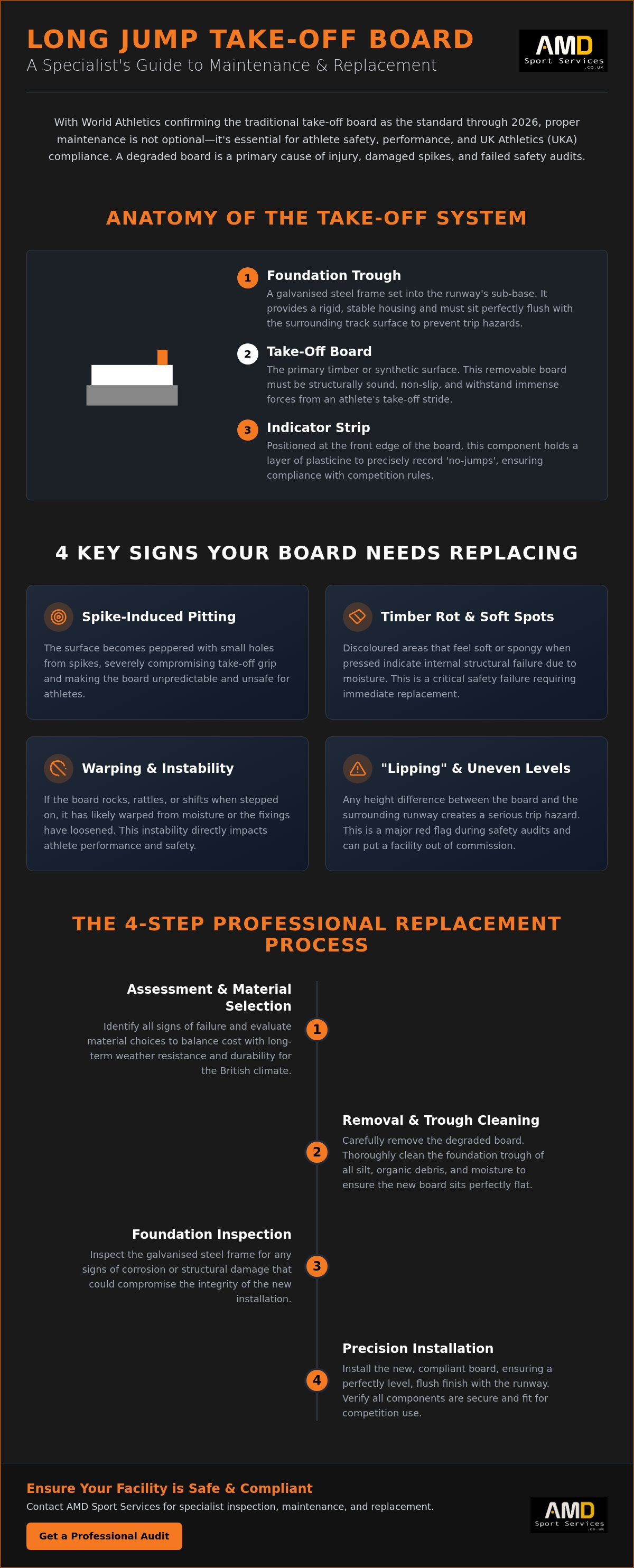
To understand a successful long jump take off board replacement, you must first view the assembly as a complete mechanical system rather than an isolated component. In the context of a competitive long jump, the take-off area consists of three distinct parts: the foundation trough, the take-off board itself, and the indicator strip. This integrated unit must work in unison to provide a stable, compliant surface that withstands the significant horizontal and vertical forces exerted during an athlete's final stride.
The trough is typically a galvanised steel frame set into the concrete sub-base of the runway. Its job is to provide a rigid, permanent housing for the removable timber or synthetic boards. Without this stable foundation, the board would shift under the high-velocity impact of an athlete's foot, leading to inaccurate measurements or significant injury. The indicator strip is the final component, sitting at the front edge of the board. It's designed to hold a thin layer of plasticine to record "no-jumps" with absolute precision. This part of the system ensures compliance with UKA and World Athletics competition rules, making it indispensable for sanctioned events.
The Role of the Foundation Trough
The foundation trough acts as the structural anchor for the entire take-off area. It must sit perfectly flush with the surrounding tartan track to ensure athlete safety. Any deviation in level, even by a few millimetres, creates a trip hazard or a "dead spot" where energy is lost during the jump. Over time, these troughs often collect silt and organic debris. If this isn't cleared during a long jump take off board replacement, the new board won't sit flat. This leads to rocking, which accelerates wear on both the timber and the steel housing. Regular cleaning and inspection of the galvanised frame are essential to prevent corrosion from compromising the runway's integrity.
Blanking Boards vs. Take Off Boards
Many athletics facilities use multi-use runways where the jump pit isn't always the primary focus. In these cases, blanking boards are used. These are essentially dummy boards surfaced with the same synthetic material as the runway. They fill the trough to create a continuous, safe running surface for athletes who aren't jumping. It's vital that these blanking boards are maintained with the same care as the take-off boards. A "lip" between the blanking board and the runway is a frequent cause of ankle rolls and falls. Ensuring a flush fit requires a clean trough and a board that hasn't warped due to moisture absorption. For sites that host various sports, having a dedicated set of blanking boards is a pragmatic way to extend the life of your competition equipment.
Signs Your Long Jump Board Requires Replacement
Identifying the exact moment for a long jump take off board replacement isn't always about waiting for a visible break. Often, the signs are more subtle, manifesting as a loss of performance or a minor change in the board's sound when struck. One of the most common indicators is spike-induced pitting. As athletes repeatedly drive their spikes into the timber, the surface becomes peppered with small holes. This doesn't just look untidy; it significantly compromises the take-off grip, making the surface unpredictable for the jumper during that critical final stride.
Environmental factors also play a major role. Because these systems are exposed to the British weather, timber rot is a constant threat. You can check for this by pressing a screwdriver into any discoloured areas; if the wood feels soft or spongy, the internal structure has failed. If you encounter these soft spots, a long jump take off board replacement is the only safe remedy. Similarly, if the board rattles or shifts when stepped on, it has likely warped or the fixings have loosened. This instability is a clear signal that the board is no longer fit for purpose. While a fresh coat of paint might improve the appearance, it won't restore the structural integrity of a rotting or delaminated board.
Physical Degradation and Performance
Worn boards have a direct impact on athlete confidence. If a jumper senses even a slight wobble or a lack of grip, they'll subconsciously alter their take-off mechanics to compensate, which often leads to poor performance or fouls. There's also the physical risk of splintering timber. A degraded board can shed sharp fragments upon impact, posing a serious risk to athletes' feet or hands during landing. A board is considered to have failed under UKA safety standards when it can no longer provide a level, non-slip, and structurally sound surface that meets the dimensional tolerances specified for competition.
Safety Audit Red Flags
During a professional sports equipment safety inspection, auditors look specifically for "lipping." This occurs when the board sits higher or lower than the surrounding runway, creating a dangerous trip hazard for anyone using the track. We also examine the galvanised frame for loose fixings or corrosion that might allow the board to move during use. If your facility hasn't had a recent check, it's worth booking a specialist assessment to ensure your equipment remains compliant and safe for all users. These audits often catch structural issues that are invisible to the untrained eye but critical for the long-term health of your athletics infrastructure.
Selecting the Right Replacement Materials
Selecting the correct material for a long jump take off board replacement is a balance of upfront cost and long-term durability. For most facility managers, the choice usually sits between traditional timber and modern synthetic-topped composites. Each material has specific maintenance requirements and performance characteristics that dictate its suitability for different levels of competition and frequency of use.
Traditional softwood boards are the most common choice for primary schools and local authority leisure centres due to their lower initial price point. However, these are the most susceptible to the rot and pitting discussed in previous sections. Hardwood alternatives offer a denser grain that resists spike damage for longer, though they still require regular weather-resistant coatings to survive the damp British climate. We always recommend opting for pre-drilled timber. This ensures the board fits the existing galvanised frame with millimetre precision, reducing the risk of the "rattle" that leads to structural instability and uneven wear.
Timber vs. Synthetic Options
Softwood: Economical and easy to replace, but prone to moisture absorption and splintering if not treated annually.
Hardwood: Highly durable and resistant to deep spike pitting, making it the pragmatic choice for club-level tracks.
Synthetic-topped: These boards feature a polyurethane or rubberised surface bonded to a rigid core. They're excellent for high-traffic facilities because they don't rot and provide a consistent grip that mimics the runway surfacing.
Whilst synthetic boards represent a higher initial investment, they significantly reduce the frequency of replacement. They're particularly effective in urban leisure centres where runways see daily use throughout the year. Regardless of the core material, the surface must be compatible with standard athletics spikes to prevent slips during the high-velocity final phase of the jump.
UKA and World Athletics Specifications
Meeting the technical requirements for sanctioned competitions is non-negotiable for club and stadium facilities. Standard UKA-compliant boards must measure 1.22 metres in length and 20 centimetres in width. The white take-off area requires a non-slip finish that remains effective even in wet conditions. When ordering your long jump take off board replacement, you must also specify the indicator cut-out type. Most modern systems use a chamfered edge to house the plasticine indicator strip, though some older galvanised troughs may still require a traditional 90-degree cut-out. Choosing the wrong profile will prevent the indicator strip from sitting flush, which can lead to inaccurate foul calls or "no-jump" disputes during competition.
The Professional Replacement Process
Executing a professional long jump take off board replacement requires a methodical approach that extends beyond the timber surface. It begins with the extraction of the old unit using specialist lifting hooks to prevent damage to the surrounding track. Once the board is removed, the focus shifts to the foundation. We often find that years of neglect lead to silt accumulation that physically prevents a new board from sitting flush. This stage is critical; if you skip the deep clean, the new board will inevitably rock, leading to premature failure and potential athlete injury.
After clearing the trough, we inspect the galvanised steel frame for signs of corrosion or structural shifting. If the trough has moved over time due to ground heave or poor initial installation, it must be adjusted before the new board is secured. We verify the level of the new assembly against the adjacent long jump runway installation to ensure a seamless transition. Finally, the "no-jump" indicator strip is tested for a snug, movement-free fit. Any play in the indicator strip can lead to vibration, which often causes the plasticine to crack or fall away during a competition.
Trough Preparation and Cleaning
Removing silt and debris is essential for the long-term health of the board. Silt traps moisture against the underside of the timber, which accelerates rot even in treated hardwoods. During the cleaning process, we pay close attention to the drainage holes at the base of the trough. If these are blocked, standing water will sit under the board, causing it to swell and warp. We also clear the "indicator shelf" where the plasticine or rubber strip rests. A single pebble or clump of dirt on this shelf will prevent the indicator from sitting level, which compromises the accuracy of foul calls. If your trough requires structural repair before a new board can be fitted, consider our specialist installation and refurbishment services to restore the area to competition standards.
Achieving a Flush Finish
A flush finish is the hallmark of a high-quality installation. We use technical shims or adjustable base plates to match the board height exactly to the runway surfacing. The goal is a seamless transition between the tartan track and the take-off area. Even a two-millimetre "lip" can cause an athlete to stumble or change their gait during the approach. Once the height is set, we perform a final safety check. This involves ensuring all bolt heads are recessed and no sharp edges are present on the galvanised frame. A secure, level board provides the stable platform athletes need to perform with confidence, whilst meeting the rigorous safety requirements of local authority and UKA audits.
Ensuring Long-Term Compliance and Safety
Maintaining a safe athletics facility requires more than just a reactive long jump take off board replacement when visible damage occurs. To meet UKA standards, facility managers must implement a proactive maintenance schedule that addresses the equipment's condition throughout the year. External equipment is particularly vulnerable to the UK's fluctuating weather, where freeze-thaw cycles can loosen fixings and heavy rain can compromise the foundation trough's drainage. Annual safety inspections are the most effective way to document compliance and identify wear before it becomes a liability for the institution.
A key part of this strategy is the integration of professional external sport equipment installation from the outset. When a system is installed correctly by specialists, it remains easier to service because the levels are precise and the fixings are accessible. AMD Sport Services plays a vital role in this ecosystem, providing the technical expertise required to keep school and club facilities aligned with national safety standards. We focus on tangible results, ensuring every component of the take-off area is structurally sound and fit for purpose, which reduces the long-term cost of ownership for the facility manager.
Annual Maintenance Cycles
During the winter months, many facilities choose to swap their competition boards for blanking boards. This simple rotation protects the more expensive take-off surface from frost damage and unnecessary wear when the jump pit isn't in use. It's also the ideal time to check the internal fixings. Extreme temperatures can cause the galvanised steel to expand and contract, which occasionally leads to bolts backing out. Keeping the white non-slip finish clean and bright is equally important. High visibility isn't just for the athletes; it's a safety requirement that helps runners distinguish the take-off area from the rest of the runway, preventing accidental stumbles during high-speed approaches.
Professional Refurbishment Services
There are instances where a long jump take off board replacement is insufficient to rectify deeper structural issues. If the surrounding tartan track is delaminating or the sub-base has subsided, a full runway refurbishment may be necessary. Integrating board replacement with athletics safety surfacing repairs ensures that the entire take-off zone remains level and secure. For educational institutions and local authorities, using a specialist contractor provides the necessary evidence for safety audits and insurance compliance. This professional oversight moves the facility from a cycle of reactive repairs to a managed infrastructure plan, providing a safe environment for athletes of all levels to compete without the risk of equipment failure.
Securing Your Facility's Competitive Future
A safe and compliant runway depends on a systematic approach to maintenance. By identifying early signs of timber decay and ensuring the foundation trough remains structurally sound, you protect both your athletes and your long-term infrastructure investment. Precision in the installation process is vital to eliminate trip hazards and maintain the accuracy required for sanctioned competitions. Transitioning from reactive repairs to a managed maintenance cycle ensures your facility remains ready for use year-round.
When a standard long jump take off board replacement is no longer sufficient to guarantee safety, professional intervention becomes necessary. With over 20 years of industry experience, AMD Sport Services provides national coverage for schools, local councils, and leisure centres across the UK. Our team specialises in UKA-compliant athletics infrastructure, ensuring every refurbishment meets the rigorous standards of modern competition whilst prioritising athlete welfare.
Don't leave your facility's safety to chance. Contact AMD Sport Services for professional long jump equipment inspections and repairs to ensure your equipment remains in peak condition. Taking these proactive steps today ensures a reliable, high-performance surface for every athlete who steps onto your runway.
Frequently Asked Questions
How often should a long jump take-off board be replaced?
Most athletics facilities require a long jump take off board replacement every one to three years, depending on usage levels and material quality. High-traffic leisure centres using softwood boards may need annual updates, whilst club tracks using hardwoods or synthetics can often extend this period. Regular inspection of the surface for deep pitting and checking the timber for soft spots are the best ways to determine the exact timing.
Can we just flip the board over if one side is worn?
You can flip the board if it is a specific reversible model designed for this purpose. However, you must inspect the underside for rot or warping before re-installing it. If the board has been sitting in a damp trough, the hidden side may already be compromised by moisture. Ensure the fixings remain secure and the board sits perfectly flush after the rotation to maintain safety standards.
What is the standard size for a UK athletics take-off board?
A standard UKA-compliant take-off board measures 1.22 metres in length and 20 centimetres in width. The depth is typically around 10 centimetres, though this can vary slightly depending on the specific galvanised trough system installed at your facility. It's essential to measure your existing trough dimensions before ordering a replacement to ensure a snug fit that prevents lateral movement during the athlete's take-off phase.
Do I need to replace the galvanised trough at the same time as the board?
You don't usually need to replace the galvanised trough unless it shows signs of structural failure or severe corrosion. Most troughs are designed to be permanent fixtures within the runway's concrete sub-base. However, if the trough has shifted due to ground movement or the drainage holes are permanently blocked, a full refurbishment may be required to ensure the new board remains level and stable over time.
Why is my take-off board rattling when athletes jump?
Rattling usually indicates that the board isn't sitting flat against the base of the trough. This is often caused by silt build-up, a warped timber board, or loose specialist fixings. If the board moves even slightly under impact, it creates a "dead" feel for the athlete and accelerates wear on the galvanised frame. Cleaning the trough thoroughly and using technical shims can often resolve these stability issues effectively.
What is the difference between a school-standard and a competition-standard board?
School-standard boards are often basic softwood units without the complex indicator strips required for sanctioned athletics. Competition-standard boards must meet strict UKA and World Athletics specifications, including a non-slip white finish and a precise cut-out for plasticine indicator strips. Competition boards are also typically made from more durable hardwoods or synthetic composites to withstand the higher impact forces and frequency of elite use.
Is it possible to replace just the timber part of a metal-reinforced board?
It is possible to replace only the timber insert if you have a metal-reinforced carrier system. These modular units allow you to unscrew the worn timber and bolt in a fresh pre-drilled section. This is a cost-effective way to manage a long jump take off board replacement, as it preserves the expensive metal housing whilst providing a brand-new take-off surface that meets all relevant competition and safety requirements.
How do I ensure the replacement board is level with the surrounding track?
Ensuring the board is level requires a perfectly clean trough and the strategic use of shims or adjustable base plates. Use a straight edge to check the transition between the tartan track and the board surface. The board must sit flush with the runway to prevent trip hazards. If the trough itself is uneven, you may need to adjust the foundation before the board can be safely secured for use.


Comments