
Football Goal Wheeling Device Replacement: A Practical UK Facilities Guide

Aluminium channel goals are particularly prone to frame and wheel damage because the wheels are typically bolted onto a thin section of the aluminium frame. Handling and storage practices can increase the load on this vulnerable connection: leaving goals resting on their wheels when not in use instead of lowering them, leaving wheels unevenly deployed with some raised and some lowered, or moving goals with only one person rather than the recommended 2 to 4 people can all stress and damage the frame and wheeling mechanisms.
These practices frequently lead to significant damage, requiring frequent replacement of frame sections and wheeling mechanisms. Facilities should consider modifying the manufacturer’s mounting system to provide better support for both the frame and the wheeling device. Adopting 360-degree wheel variants that wrap around the entire sidebar, rather than bolting to a thin section, can reduce structural stress when the goal is manoeuvred in directions other than a straight line.
If a goal has become difficult to move, the fault may be limited to the football goal wheeling device, or it may involve the fixing points, frame or moving mechanism. This guide explains what to look for, which details help assess compatibility and when a wider repair may be needed. For schools, councils, leisure centres and sports clubs, recording the symptoms and keeping the goal out of use until it has been assessed helps make the next step clear. AMD Sport Services inspects and repairs football goals, assessing the football goal wheeling device as part of the complete assembly.
Football goal wheeling device replacement: when is it needed?
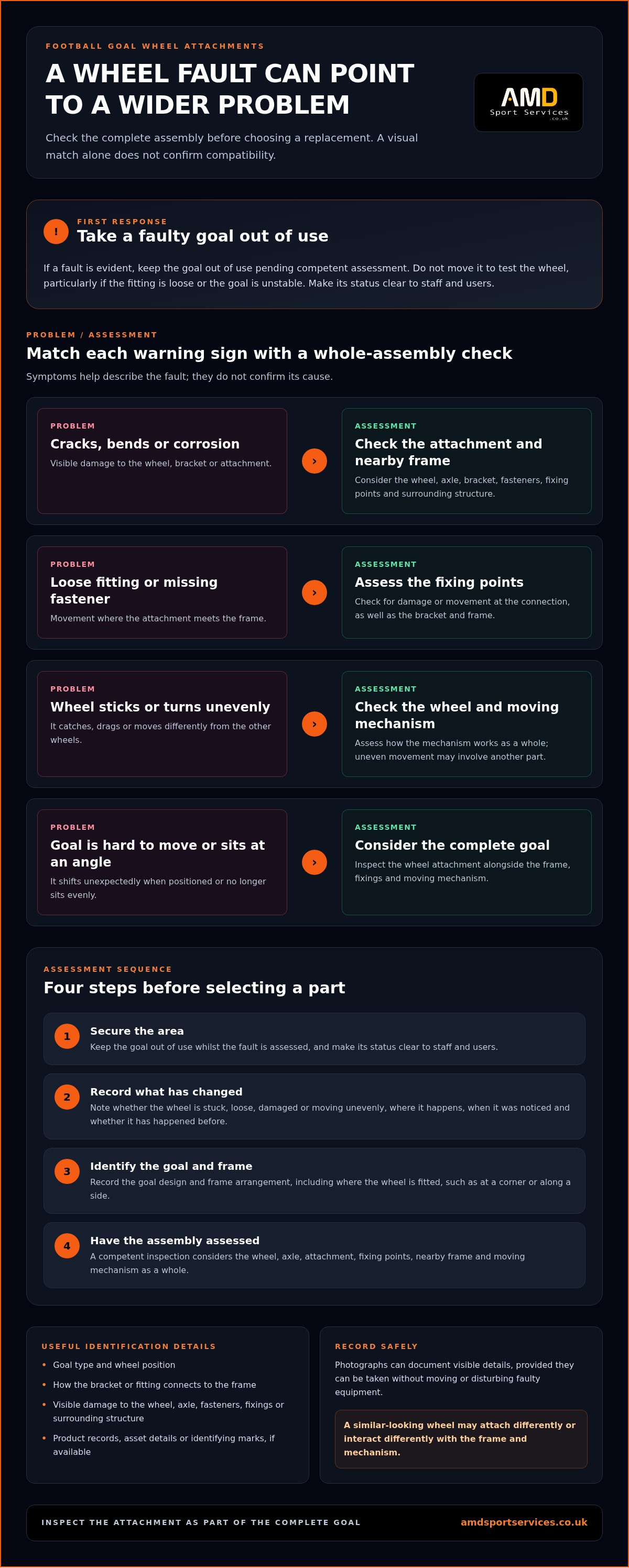
A goal that no longer moves smoothly, sits evenly or stays in position as expected needs assessment before anyone attempts to move or use it. Football goal wheeling device replacement may resolve a local fault, but the football goal wheeling device is only one part of the assembly. The frame, fixing points and moving mechanism all affect how the goal handles, so assess the complete equipment before deciding what to replace.
With the goal out of use, note any visible or operational changes, including:
Cracks, bends to the goal mounting point and surrounding area, corrosion or other visible damage to the wheel, bracket or football goal wheeling device.
A loose fitting, missing fastener or movement where the football goal wheeling device meets the frame.
A wheel that sticks, fails to turn or moves unevenly compared with the other wheels.
A goal that has become harder to move, sits at an angle or shifts unexpectedly when positioned.
These signs help describe the fault, but none confirms its cause or the condition of the whole goal. A damaged wheel may have a sound fixing point; an apparently minor wobble could instead involve the bracket, frame or moving mechanism. Don’t force a stiff wheel or treat a quick visual check as a substitute for competent inspection.
What signs suggest a football goal wheeling device is damaged?
Look for changes in the goal’s usual movement and position. A wheel that catches, drags, sits at an angle, or does not freely turn can make manoeuvring difficult. Looseness, distortion or cracking around the bracket may indicate damage to the football goal itself. Uneven movement can also result from a problem with a fixing point or another part of the mechanism. Record what you observe and where it occurs, but don’t use one symptom alone to decide whether the goal is safe to use.
Can a faulty wheel affect the whole goal?
Yes. A faulty football goal wheeling device can make controlled movement difficult and affect how the goal is positioned or secured. A local wheel issue may be repairable, but damage around the frame or fixing points can call for wider work. Since a Football Goal depends on its assembled parts working together, assess the football goal wheeling device alongside the structure and mechanism rather than treating it as an isolated spare.
If a fault is evident, take the goal out of use pending competent assessment. Don’t move it to test whether the wheel still works, particularly if the fitting is loose or the goal is unstable. An inspection can establish whether the problem is confined to the football goal wheeling device or extends to the frame, fixings or moving mechanism. That distinction helps determine whether the football goal wheeling device needs repair or the complete goal requires further work. AMD Sport Services provides sports equipment inspections, maintenance and football goal repairs.
How to assess the goal before choosing a replacement football goal wheeling device
Before selecting a part, establish what has failed and whether the fault is limited to the wheel assembly. A football goal wheeling device replacement chosen by appearance alone may not suit the goal’s frame or fixing arrangement. Keep the area controlled, record the fault, identify the goal and have the football goal wheeling device and surrounding structure assessed. Don’t move or handle a goal with an evident fault just to gather information.
Secure the area. Keep the goal out of use while the fault is assessed, and make its status clear to staff and users.
Record what has changed. Note whether the wheel is stuck, loose, damaged or moving unevenly, and where the issue occurs. Record when it was noticed and whether it has happened before.
Identify the goal and frame. Record the goal design and frame arrangement, including where the wheel is fitted, such as at a corner or along a side.
Assess the assembly. A competent inspection should consider the wheel, axle, football goal wheeling device, fixing points and nearby frame for visible damage or movement, as well as how the moving mechanism works as a whole.
Which details help identify the existing football goal wheeling device?
Useful records include the goal type, manufacturer, the wheel’s position and how its bracket or other fitting connects to the frame. Note visible damage to the wheel, axle, fasteners, fixing points, handle, and surrounding structure. Include product records, asset details or identifying marks if available. Photographs can document what is visible, provided they can be taken without moving or disturbing faulty equipment.
These details give a better basis for assessing compatibility than a visual match. Two wheels can look similar while differing in how they attach or interact with the frame and mechanism. The replacement needs to suit the actual assembly, not simply resemble the damaged part.
Why assess the goal frame as well as the wheel?
A loose or distorted fixing point can change the repair required, even if the wheel appears to be the main problem. A worn football goal wheeling device is different from damage to the frame or the area where the fitting connects. Assess the cause before repair, then consider the complete goal before returning it to use.
The FA Goalpost Safety Guidelines provide relevant safety context for facilities managing football goals. AMD Sport Services assesses and repairs football goals, taking the football goal wheeling device and wider assembly into account. Our sports equipment maintenance work can address faults identified during an assessment.
Replacement football goal wheeling device options: what should facilities compare?
A suitable replacement is determined by how the wheel assembly fits and functions on the particular goal, not by whether a spare looks similar. Compare the existing football goal wheeling device with the goal’s design and condition before deciding whether the work is limited to one component or needs a wider repair. This keeps the choice grounded in the equipment’s actual configuration rather than assumptions about interchangeability.
Use these four checks to organise the assessment:
Compatibility: Compare the football goal wheeling device’s position and fixing arrangement with the proposed component. It needs to connect appropriately to the goal as built.
Football goal wheeling device condition: Establish whether the fault is confined to the wheel component, or whether the axle, bracket, fasteners or other parts of the assembly are also affected.
Goal condition: Consider the frame and surrounding fixing points. Damage or movement there may mean replacing the wheel alone will not address the cause.
Intended use: Consider the goal’s usual handling and positioning. The football goal wheeling device must function as part of the complete assembly, not just fit in isolation.
There is no universal wheel type or specification for every goal. Details depend on the individual goal and its existing arrangement. An assessment-led football goal wheeling device replacement is less likely to leave a mismatch or unresolved fault than a choice based on appearance alone.
How can you judge whether a replacement is compatible?
Start with the goal identification and assessment findings. Compare where the current football goal wheeling device sits, how it connects to the frame and how it relates to the moving mechanism. Then assess whether the proposed component matches that arrangement. Similar shape or appearance is not proof of suitability, and football goal wheeling devices should not be assumed to interchange across different goal designs.
Where records or markings are available, they can help identify the goal and its existing assembly. If they are unavailable, the physical arrangement and condition still need assessment. Keep compatibility and condition separate: a component may appear to fit, while the surrounding fixing point is damaged or unsuitable for the repair as planned.
When is a wider football goal repair more appropriate?
A wider repair may be needed if assessment finds damage beyond the wheel, such as an affected bracket, fixing point or frame. It is not uncommon for us to unbolt a wheeling device and find the aluminium rail is cracked. Meaning a new wheeling device in the same location will cause the exact same issue again. Sometimes sidebars require replacing along with the new wheeling device.
Changes in how the complete goal moves can also indicate that the wheel is not the only part requiring attention. If the fault is confined to the football goal wheeling device and the surrounding structure is in suitable condition, the repair may focus on that assembly. The appropriate scope follows the findings, not a preset assumption.
AMD Sport Services assesses and repairs football goals, considering the football goal wheeling device alongside the frame and overall movement. This helps distinguish a component replacement from a more extensive repair, so the work addresses the identified fault before the goal returns to use.
Football goal wheeling device replacement: a safety-led repair process
A considered repair follows a clear sequence: assess the goal, keep it out of use while the fault is addressed, identify the cause, complete the appropriate work and check the result. The replacement must suit the goal’s frame and fixing points as well as the wheel assembly. Fitting a part without considering those connections can leave the original fault unresolved.
Technical repair work should be carried out by competent personnel. Improvised fitting or alterations can affect how the football goal wheeling device connects to the goal, so a football goal wheeling device replacement should be based on the equipment’s condition rather than a quick fix. AMD Sport Services assesses and repairs football goals, from football goal wheeling device faults to wider damage identified during inspection.
What happens during a professional replacement assessment?
The assessment starts with the football goal wheeling device, its fixings and the nearby frame. The equipment is checked for visible damage, looseness or movement, then the fault is considered in relation to the other parts of the goal. Findings inform the repair approach, which is tailored to the goal’s design and condition rather than assumed from the appearance of a spare.
Where the assessment shows that the wheel assembly is the source of the problem and the surrounding structure is suitable, work can focus on the football goal wheeling device. If damage extends to a fixing point or frame, that broader issue needs to be addressed as part of the repair. AMD Sport Services’ sports equipment service and maintenance includes assessment and repair work that considers the fault in context.
What should be checked before the goal returns to use?
After repair, the football goal wheeling device should be checked to ensure it is secure and operates as intended. The goal’s movement and stability should also be reviewed as part of the completed work, since a functioning wheel alone does not establish that the complete assembly is ready for use. Any findings requiring follow-up maintenance can be recorded in the facility’s equipment records.
Return the goal to use only after the repair and its condition have been reviewed. If movement remains uneven, a fixing shifts or the goal does not behave as expected, arrange further assessment before it goes back into service. Recording the fault, repair and checks helps staff understand what was addressed and make consistent maintenance decisions.
For schools, councils, leisure centres and sports clubs, this process connects the initial fault to a considered repair and final check. Arrange football goal repair and maintenance with AMD Sport Services to have the football goal wheeling device and complete goal assessed together.
Arrange football goal wheeling device replacement with AMD Sport Services
A fault report is the starting point, not the repair specification. The next step is to assess the complete goal and establish whether the appropriate response is a focused football goal wheeling device repair or wider work. This avoids replacing a component based on appearance alone and keeps the decision tied to the equipment’s condition. Keep the goal out of use until the fault has been assessed and addressed.
AMD Sport Services carries out football goal repairs for facilities that need practical assessment and maintenance. We consider the football goal wheeling device alongside its fixing points, the frame and the goal’s overall movement. That wider view helps clarify the repair required and whether other faults need attention as part of the same job.
What facilities gain from a repair-led approach
A repair-led approach connects the football goal wheeling device fault to the goal’s condition and how the equipment is used. Assessment can distinguish a problem confined to the wheel assembly from damage involving the frame or fixing points. The repair can then be scoped to the findings, rather than assuming that every fault calls for the same work. The appropriate response depends on the goal’s condition.
How to move from a fault report to completed repair
Clear information helps build an accurate picture of the issue. When reporting a fault, include the goal type or any identifying details available, what the wheel is doing differently and where the football goal wheeling device is positioned. Note whether the goal has become difficult to move or whether the frame or fixing point also appears affected. A brief description of where the goal is kept and how it is normally handled can add useful context.
Goal details: Describe the goal design and any records or markings that help identify it.
Fault symptoms: Explain what you have observed, such as a wheel that sticks, moves unevenly or appears loose.
Site context: Share relevant access or handling considerations for the assessment.
AMD Sport Services can then assess the equipment and carry out the appropriate football goal repairs. Findings guide the work, whether the issue is local to the football goal wheeling device or requires a broader repair. After the work, the goal’s movement and stability should be reviewed before it returns to use. This connects the initial report, assessment and repair to the actual condition of the equipment.
If a football goal wheeling device fault is affecting a goal at your school, council, leisure centre or sports club, discuss your football goal repair requirement with AMD Sport Services.
Get the goal ready for its next move
A wheel fault is also a prompt to review how equipment issues are passed between staff. Make sure the person responsible for the goal knows it needs attention, and follow the repair request through, particularly where equipment is shared. A clear handover helps prevent an unresolved maintenance issue from being overlooked.
For football goal wheeling device replacement, AMD Sport Services helps facilities move from a reported problem to the appropriate football goal repair. Our sports equipment inspection and maintenance work supports facilities across the UK.
To arrange an assessment and repair, contact AMD Sport Services about your football goal.
Frequently Asked Questions
How do I know if a football goal wheeling device needs replacing?
Look for a wheel that sticks, bends, drags or moves unevenly, or for looseness, visible damage or movement around the football goal wheeling device. These signs indicate that the goal needs assessment, but they do not establish the cause or show whether the fault is limited to the wheel. Keep the goal out of use and record which goal is affected, when the issue was noticed and what you observed. A competent inspection can determine the appropriate repair.
Can I replace just one football goal wheeling device on a football goal?
That depends on the condition and design of the particular goal. If the fault is confined to one football goal wheeling device and the surrounding frame and fixing points are in suitable condition, the repair may focus on that assembly. If the assessment finds damage elsewhere, wider work may be needed. Don’t assume that replacing one part will resolve the issue without assessing the complete goal.
Are football goal wheeling devices universal?
No. Football goal wheeling devices can differ in their position, fixing arrangement and relationship to the goal’s frame and moving mechanism. Keep any goal records, purchase details or previous repair notes available to help identify the equipment. If a removed part is retained for identification, label it with the goal it came from. Records support the assessment, but do not by themselves establish that a replacement is suitable.
Is it safe to use a football goal with a damaged football goal wheeling device?
If the goal’s handling or stability is in doubt, take it out of use until the fault has been assessed. Tell relevant staff that it is unavailable and update the facility’s equipment records so its status is clear. A repair note can record when the goal was taken out of use and when its status was reviewed.
What information helps identify a replacement football goal wheeling device?
Include the goal’s design, the football goal wheeling device’s position and details of how it connects to the frame. Add its asset number or other site identifier if available, along with the date the issue was first noticed and any relevant maintenance history. A photograph taken without touching or moving the goal can help show the fitting’s condition and location. These details help match observations to the correct equipment.
Can a football goal wheeling device fault indicate damage elsewhere?
It can. A loose or damaged football goal wheeling device may be associated with an issue at the bracket, fixing point or frame, and uneven movement can have more than one cause. Share previous inspection notes or repair records if a similar issue has been reported before. The history provides useful context, but the goal still needs an assessment based on its current condition.
Who can carry out football goal wheeling device replacement?
Use competent sports equipment repair personnel for this work. AMD Sport Services carries out football goal repairs as part of its sports equipment inspection and maintenance work across the UK. When reporting a fault, provide the goal’s site identifier, what the wheel is doing and any relevant maintenance records. This gives the assessment a clear starting point.

Comments