
A Comprehensive Guide to Sports Hall Partition Netting and Division Systems

Your sports hall’s revenue potential is strictly limited by how effectively you can divide its floor space. It’s a common frustration to see half a hall sitting empty because you don't have the infrastructure to safely host a five-a-side match alongside a gymnastics class. Without professional sports hall partition netting, stray balls and noise interruptions make simultaneous bookings nearly impossible, leaving you with wasted space and missed opportunities. You need a solution that balances high-intensity use with strict health and safety compliance.
We understand that managing overhead equipment comes with a heavy responsibility for safety and durability. This guide will show you exactly how to maximise your facility’s utility while meeting essential standards like BS 5867 Part 2 Type B for fire retardancy. We will preview the different mesh options for various sports, explain the mechanics of trackway systems, and outline the inspection regimes needed to keep your equipment in top condition. By the end, you'll have a clear roadmap for creating a versatile, multi-sport environment that satisfies both your users and your safety inspectors.
Table of Contents
What is Sports Hall Partition Netting and Why is it Essential?
A sports hall is often the largest single asset in a school or leisure centre, yet its potential is frequently stifled by a lack of physical separation. Sports hall partition netting is a retractable divider system, typically suspended from a ceiling-mounted trackway, designed to transform a single expansive area into multiple independent zones. Unlike permanent walls, these systems offer the agility to reconfigure a hall in minutes, allowing a facility to transition from a full-court basketball game to four separate badminton courts or a gymnastics circuit.
The primary objective is the safe containment of sports equipment and participants amongst different activity zones. Without these barriers, high-velocity objects like footballs or shuttlecocks pose a constant risk to groups in adjacent sections. From a business perspective, the ability to host simultaneous bookings is the most direct way to increase revenue. A hall that can only be booked by one group at a time is a hall that is under-performing. Professional sports hall partition netting ensures you don't leave money on the table by leaving half your hall empty.
The Role of Netting in Multi-Sport Environments
Efficiency in a sports hall relies on minimising downtime and distractions. Professional netting systems do more than just stop balls; they provide a visual and acoustic buffer that helps athletes stay focused. In a typical multi-use scenario, you might have a noisy five-a-side football match happening alongside a focused gymnastics session. High-quality netting reduces the visual clutter of the hall, creating a more professional atmosphere for both competitive clubs and educational groups. This separation is vital for maintaining the flow of a lesson or training session, ensuring that different activities don't bleed into one another.
Safety and Liability Considerations for Facility Managers
For those responsible for public or institutional buildings, the installation of partition netting is a critical component of a comprehensive facility risk assessment. Inadequate or poorly maintained division systems are a significant liability. In school environments, the risk of cross-zone accidents is particularly high, as students may chase stray equipment into the path of other players. It's a preventable hazard that requires technical foresight.
Ensuring these systems are fit for purpose isn't just about the initial install. It requires ongoing vigilance. Regular indoor inspection and maintenance is necessary to identify frayed mesh, trackway obstructions, or failing fixings before they become a hazard. A well-installed and properly inspected system provides peace of mind, demonstrating that the facility manager has taken reasonable steps to protect users from predictable risks.
Technical Specifications: Mesh Sizes, Materials, and Track Systems
Selecting the right sports hall partition netting requires a pragmatic look at how different materials and dimensions impact long-term safety and functionality. It isn't a one-size-fits-all product. You must account for the specific ball types used in your facility and the structural limits of your ceiling. Reviewing technical specifications for sport nets is a necessary step for facility managers planning a new installation to ensure the equipment matches the building's architectural capabilities.
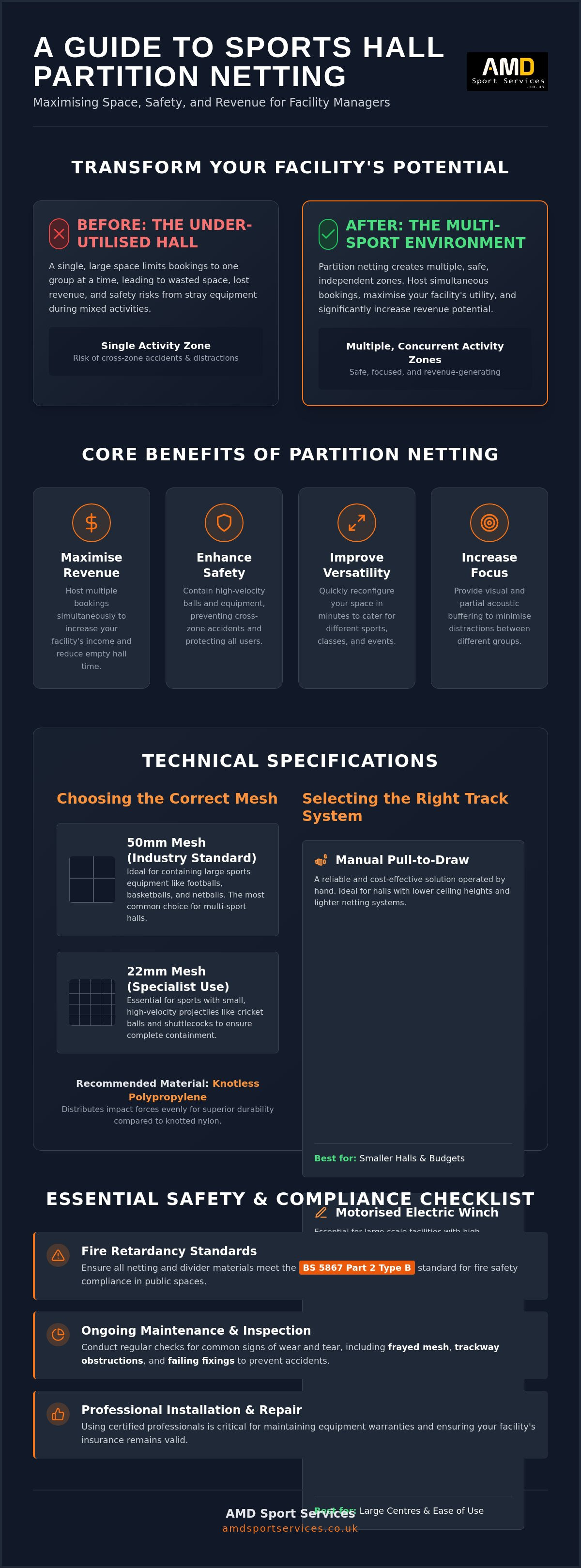
The choice between manual pull-to-draw systems and motorised electric winches often depends on the height of the hall and the weight of the netting. For smaller halls with lower ceilings, a manual system is cost-effective and reliable. However, for large-scale leisure centres where netting may span 30 metres or more, motorised systems are essential to prevent strain on staff and ensure the nets are stored correctly at height when not in use.
Choosing the Correct Mesh for Your Activities
The industry standard for general multi-sport use is 50mm mesh. This size is ideal for containing footballs, basketballs, and netballs. However, if your facility hosts cricket, you must specify a 22mm mesh. Smaller projectiles will pass straight through 50mm holes, rendering the barrier useless and dangerous. We recommend knotless polypropylene for the netting material. Unlike traditional knotted nylon, knotless polypropylene distributes impact forces more evenly across the mesh. It's more durable and less prone to fraying at the junctions. Crucially, all netting must be treated for fire retardancy to meet UK building regulations, specifically BS 5867 Part 2 Type B.
Tracking and Suspension Mechanisms
The trackway is the backbone of any division system. We use heavy-duty aluminium trackways designed to carry the significant weight of the netting and the integrated sight screens. These tracks rely on high-quality trolleys and nylon runners to ensure smooth, silent operation. If the runners start to stick, it's usually a sign of track misalignment or debris buildup. Before any new installation, a structural assessment of the ceiling fixings is mandatory. You cannot simply bolt these systems into any beam; the support structure must be capable of handling both the static weight and the dynamic force of balls hitting the net. If you're unsure about your current system's load-bearing capacity, a professional safety inspection can identify potential failure points before they become dangerous.
At the base of the netting, a canvas sight screen is typically installed. This usually reaches two metres high and serves a dual purpose. First, it provides a visual barrier that stops players from being distracted by movement in the next zone. Second, it adds the necessary weight to the bottom of the net, ensuring it hangs straight and doesn't billow when hit by a ball or caught in a draught. This combination of technical mesh and solid canvas creates a robust, professional environment for all users.
Selecting the Right Division Netting for Your Facility
Specifying the correct sports hall partition netting involves more than just measuring the floor space. You must consider the logistical transition between different sports. If your facility transitions from indoor cricket in the morning to five-a-side football in the evening, your tracking layout must accommodate both specific lane configurations and broad hall divisions. A common error is installing a single track that lacks the flexibility for multi-bay setups, forcing staff to manually move heavy equipment and increasing the risk of track damage. We recommend a layout that allows for rapid reconfiguration without compromising the tension or safety of the mesh.
Determining the optimal dimensions is the next technical step. Sport England recommends a minimum clear height of 7.5m for most indoor sports, meaning your trackway and suspension system will likely sit at 8m or higher. When measuring for height, we always include a "lead-weighted" bottom edge that sits flush with the floor. For width, we calculate a necessary overlap, typically between 500mm and 1000mm at the meeting points. This ensures a complete seal that prevents balls from passing through gaps between different netting sections. Without this overlap, the system fails its primary safety function.
The choice between single-track and twin-track systems depends on your hall’s layout. Single-track systems are efficient for simple half-hall divisions. Twin-track systems, however, allow nets to bypass one another or form enclosed bays, which is essential for cricket lanes. Storage is another critical factor. You don't want nets bunched up in corners where they become a trip hazard or attract dust. We provide various storage solutions, including wall-mounted heavy-duty bags or lath systems that keep the netting protected and out of the way when the full hall is required for events or exams.
Bespoke Netting for Schools and Education Centres
In an educational setting, equipment must be robust enough to withstand daily, heavy-handed use by students and staff. We prioritise ease of use for PE teachers, ensuring that manual pull systems are geared for low-effort operation. Integrating solid sight screens into the lower section of the net is particularly beneficial for schools. These screens help students focus by blocking visual distractions from other classes. They are also invaluable during exam periods, effectively turning a noisy sports hall into a series of private, quiet zones.
Commercial and Leisure Centre Requirements
For commercial leisure centres, durability and aesthetics are the driving factors. High-turnover public bookings mean the sports hall partition netting is moved multiple times a day. We focus on industrial-grade runners and trolleys that can handle this constant cycle without sticking. Colour choices also matter; whilst standard white or blue is common, bespoke colours can be used to match your facility’s branding. Our goal is to help you maximise floor space, ensuring that when the nets are retracted, they occupy the smallest possible footprint to allow for full-hall tournaments and community events. If you are planning an upgrade, our team can provide a full indoor inspection of your current structural fixings to determine the best path forward.
Essential Safety Inspections and Maintenance for Netting Systems
Annual safety inspections are not merely a recommendation; they are a fundamental requirement for UK sports facilities to ensure public liability coverage and user protection. Most insurance providers and local authorities mandate these checks to verify that overhead equipment remains structurally sound and legally compliant. Over time, even the most robust sports hall partition netting will experience mechanical fatigue. Identifying early signs of wear prevents a minor issue from escalating into a catastrophic failure that could result in injury or significant facility downtime. Regular maintenance doesn't just satisfy a compliance checklist; it protects your long-term capital investment by extending the operational life of the tracks, runners, and mesh.
The Inspection Checklist: What the Experts Look For
A professional inspection follows a methodical sequence to assess every component of the division system. We begin at the highest point, examining the integrity of the trackway and the security of all ceiling-mounted brackets to ensure they haven't shifted under the dynamic load of regular use. We then test the tension and security of the wire ropes and pulleys, as these are the primary points of mechanical stress. Finally, we examine the netting itself for holes, tears, or fraying that could compromise the barrier's safety or allow projectiles to pass through. BS EN standards for indoor sports equipment safety provide the technical benchmarks for load-bearing capacity, stability, and entrapment prevention to ensure all installations remain fit for purpose.
Routine Maintenance Tasks for Facility Staff
Whilst annual professional checks are mandatory, the daily behaviour of facility staff has the biggest impact on the system's longevity. When drawing or retracting the nets, staff should move at a steady pace to avoid snagging the mesh on obstacles or causing the runners to jump the track. If a track feels stiff or a runner begins to stick, don't force it; this usually indicates a misalignment or debris buildup that requires adjustment. Proper storage is equally vital. Netting should never be left bunched on the floor where it can be caught by footwear or cleaning equipment. Instead, utilise wall-mounted bags or lath systems to keep the material protected from dust and physical damage. If you notice any loose fixings or significant tears, you must call for a professional repair immediately rather than waiting for your next scheduled check. You can book a comprehensive sports equipment safety inspection to ensure your hall remains fully compliant and safe for all users.
Professional Installation and Repair: Ensuring Long-Term Compliance
Attempting DIY repairs on overhead sports hall equipment is a high-risk strategy that rarely pays off. These systems are heavy, mechanically complex, and suspended at heights that require specialist access equipment. A botched repair on a trackway or a poorly secured winch can lead to catastrophic mechanical failure. Beyond the immediate physical danger, unauthorised modifications usually void your manufacturer’s warranty and can invalidate your facility’s insurance policy. If an accident occurs and the equipment was not maintained by a competent professional, the liability rests solely with the facility manager. Professional installation and repair provide the technical accountability required for public and institutional buildings.
AMD Sport Services approaches every project with a focus on structural integrity and bespoke fit. We don't believe in a one-size-fits-all replacement policy. When we assess an aging system, we evaluate the cost-effectiveness of targeted repairs versus a full replacement. If your trackway is structurally sound but the mesh is frayed, we can often source and install new sports hall partition netting panels without the need for a complete overhaul. This pragmatic approach saves your budget whilst ensuring the final result meets all current safety standards. We provide a clear technical report following every visit, so you have a documented audit trail of your equipment's condition.
The Installation Process: What to Expect
Our installation workflow begins with a comprehensive site survey and a structural assessment of the roof space. We need to verify that the existing beams can handle the static and dynamic loads of the new system. Once the design is finalised, we organise the installation to minimise facility downtime, often working during holiday periods or off-peak hours. The process concludes with final safety testing, where we cycle the system multiple times to ensure smooth operation. We also provide on-site training for your staff, ensuring they understand how to operate the equipment safely and identify early signs of wear.
Bespoke Repairs and Replacement Parts
Maintaining sports hall partition netting often requires sourcing high-quality, specific replacement parts that aren't available through standard retail channels. We stock and install heavy-duty runners, aluminium track sections, and industrial-grade netting panels. In motorised systems, we pay close attention to alignment; even a slight deviation in the track can cause the motor to overwork, leading to premature burnout. Correcting these alignment issues early is far more cost-effective than replacing a seized motor later. Ensure your facility remains compliant by booking an indoor equipment safety inspection to identify these technical issues before they lead to equipment failure.
Optimising Your Sports Hall for Safety and Versatility
A high-performing sports hall depends on a division system that is both technically sound and legally compliant. By selecting the correct mesh size and ensuring all materials meet fire retardancy standards, you create a space that supports simultaneous bookings and protects every participant. We've seen how regular inspections and proactive maintenance prevent mechanical failures, ensuring your sports hall partition netting remains a reliable asset rather than a liability. Whether you are managing a school hall or a commercial leisure centre, the goal is always to balance operational flexibility with uncompromising safety standards.
With over 20 years of industry experience, AMD Sport Services is a specialist in UK educational and leisure facility compliance. We take pride in solving complex structural challenges with bespoke solutions that standard products cannot address. Don't wait for a mechanical failure to compromise your facility's safety or insurance validity. Contact AMD Sport Services for professional netting installation and safety inspections to ensure your equipment remains in peak condition. We look forward to helping you create a safer, more efficient multi-sport environment.
Frequently Asked Questions
How often should sports hall partition netting be inspected?
Annual safety inspections are the mandatory standard for UK sports facilities to ensure compliance with insurance and local authority requirements. These professional checks identify structural fatigue in overhead brackets or trackways that staff may miss during daily operation. We also recommend that facility managers perform basic visual checks weekly to spot obvious fraying or sticking runners before they escalate into mechanical failures.
Can I repair a tear in my sports hall netting myself?
We don't recommend DIY repairs on sports hall partition netting because of the safety risks associated with overhead equipment. Professional repairs ensure the structural integrity of the suspension system and the fire retardancy of the mesh remain intact. Unauthorised fixes can invalidate your facility’s public liability insurance and may fail to meet the load-bearing standards required for high-impact sports.
What is the difference between knotless and knotted sports netting?
Knotless netting is the modern industry standard because it distributes impact forces more effectively across the mesh junctions. Traditional knotted netting tends to wear down at the knots, which leads to premature fraying and holes. Knotless polypropylene is more durable, easier to handle, and provides a smoother finish that's less likely to snag on trackway components during retraction.
Do I need a motorised or manual partition netting system?
The choice depends on your hall's ceiling height and how often the space is reconfigured. Manual systems are a cost-effective and reliable solution for standard school halls with lower ceilings. However, for large leisure centres where nets exceed 30 metres in length, motorised systems are essential to prevent staff strain and ensure the netting is stored correctly at height when not in use.
How much space does a retracted netting system take up?
A retracted system typically occupies a very small footprint, often less than 1 metre of wall or corner space when properly bunched. We utilise wall-mounted lath systems or heavy-duty storage bags to keep the netting secure and off the floor. This ensures the full hall remains clear for events or exams without creating trip hazards or visual clutter in the corners.
What mesh size do I need for indoor cricket nets?
You must use a 22mm mesh for indoor cricket to ensure that the ball cannot pass through the barrier. Whilst 50mm mesh is the standard for football and basketball, it won't contain smaller projectiles like cricket balls or shuttlecocks. Specifying the correct mesh size is a critical safety step for any facility that hosts diverse, high-velocity sports sessions simultaneously.
Are sports hall curtains fire-rated?
Yes, all professional sports hall partition netting and curtains must be fire-retardant to meet UK building regulations. The specific requirement is BS 5867 Part 2 Type B, which is the standard for fabrics used in public and commercial buildings. We ensure every installation meets this flammability standard to satisfy local authority safety audits and comprehensive fire risk assessments.
Can you motorise an existing manual netting system?
It's often possible to motorise an existing manual system if the trackway and structural fixings are in good condition. We perform a detailed site survey to assess the load-bearing capacity of your roof beams and the alignment of the current track before recommending an upgrade. Motorisation significantly improves operational efficiency and reduces the mechanical wear caused by manual handling in high-use facilities.


Comments